networking distributedsystem/microservice kubernetes/networking
Zero Trust Security | What’s a Zero Trust Network?
Zero Trust Architecture on Kubernetes with Istio Service Mesh | by Luca Passaretta | Medium
The Fallacies of Distributed Computing > 4. Network Is Secure
Core Idea
Zero Trust means never trust, always verify: authenticate by identity instead of network location, enforce least privilege and mTLS between services, and keep verifying.
- Why perimeter security fails in microservices, where threats exist inside and outside the network.
- The seven pillars: identity-based auth, least privilege, mTLS, service mesh enforcement, micro-segmentation, short-lived credentials, continuous verification and observability.
- Key technologies section maps the pillars to tools.
“Never trust, always verify” this is the core principle of Zero Trust. Unlike traditional perimeter-based security (where everything inside the network is trusted), Zero Trust assumes that threats exist both outside and inside the network.
The Problem with Traditional Security in Microservices
In a monolith, once a request clears the firewall, it moves freely inside. In microservices, you have dozens (or hundreds) of services talking to each other — if one is compromised, an attacker can move laterally across your entire system with no friction.
Core Pillars of Zero Trust in Microservices
1. Identity-Based Authentication (Not Network Location)
Every service must prove who it is on every request — not just “it’s inside our VPC, so it’s fine.”
- Services get cryptographic identities (e.g., SPIFFE)
- mTLS (mutual TLS) ensures both caller and callee authenticate each other
- Short-lived certificates minimize breach windows
2. Least Privilege Authorization
Each service can only do exactly what it needs — nothing more.
- Service A can call Service B’s
/readendpoint but not/delete - Enforced via RBAC/ABAC policies (e.g., Open Policy Agent)
- Authorization is re-evaluated on every request, not just at login
3. Mutual TLS (mTLS) for Service-to-Service Communication
All traffic between services is encrypted and authenticated — even on the internal network.
Service A ──[client cert]──► Service B
Service A ◄──[server cert]── Service B
         Both sides verified ✓
4. Service Mesh as the Enforcement Layer
A service mesh (Istio, Linkerd, Consul) handles Zero Trust at the infrastructure level so developers don’t have to bake it into every service.
- Sidecars (Envoy proxies) intercept all traffic
- Policy is applied consistently, transparently
- Centralized observability (who talked to whom, when)
5. Micro-Segmentation
Instead of one big flat network, services are isolated into fine-grained segments with strict ingress/egress rules.
- Even if Service A is compromised, it can’t reach the Payment Service
- Enforced via Network Policies (Kubernetes) or firewall rules
6. Dynamic, Short-Lived Credentials
No long-lived API keys or passwords sitting in config files.
- Secrets managed by Vault (HashiCorp) or AWS Secrets Manager
- Tokens expire quickly and rotate automatically
7. Continuous Verification & Observability
Trust is never assumed — every request is logged and evaluated.
- Distributed tracing (Jaeger, Zipkin)
- Anomaly detection on traffic patterns
- Audit logs for every service-to-service call
Key Technologies
| Concern | Tools |
|---|---|
| Service Identity | SPIFFE, SPIRE |
| mTLS / Traffic Encryption | Istio, Linkerd, Consul |
| Policy Enforcement | OPA (Open Policy Agent) |
| Secrets Management | HashiCorp Vault, AWS Secrets Manager |
| Network Segmentation | Kubernetes Network Policies, Cilium |
| Observability | Jaeger, Grafana, Promethues |
Zero Trust in Kubernetes
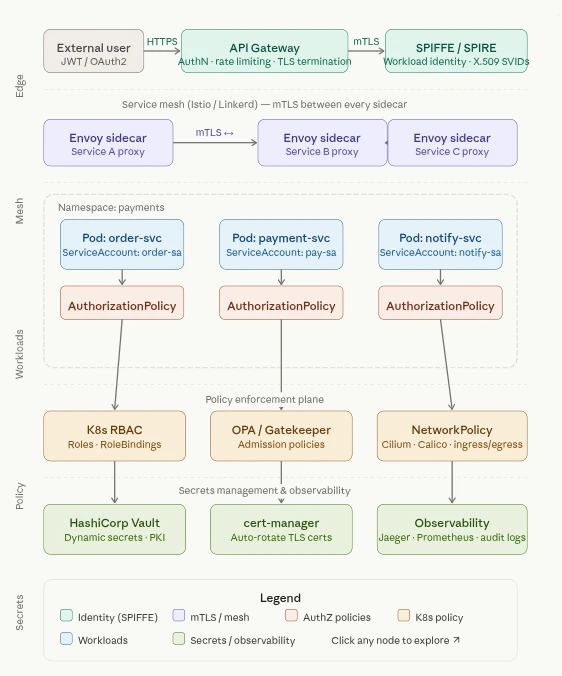
Layer 1 — Edge: Identity & Authentication
Every request entering the cluster is challenged at the API Gateway (Kong, Nginx, or AWS ALB). This is where JWT/OAuth2 tokens are validated. No token, no entry.
SPIFFE/SPIRE issues cryptographic SVID (SPIFFE Verifiable Identity Document) certificates to every workload — these short-lived X.509 certs replace long-lived passwords and API keys entirely.
# PeerAuthentication — enforce mTLS cluster-wide
apiVersion: security.istio.io/v1beta1
kind: PeerAuthentication
metadata:
  name: default
  namespace: istio-system
spec:
  mtls:
    mode: STRICT  # No plaintext allowed anywhere
Layer 2 — Service Mesh: mTLS Everywhere
Istio injects an Envoy sidecar into every pod. All service-to-service traffic is automatically encrypted and mutually authenticated — developers don’t write a single line of TLS code.
# AuthorizationPolicy — deny all, then allow only what's needed
apiVersion: security.istio.io/v1beta1
kind: AuthorizationPolicy
metadata:
  name: payment-allow
  namespace: payments
spec:
  selector:
    matchLabels:
      app: payment-svc
  rules:
  - from:
    - source:
        principals: ["cluster.local/ns/payments/sa/order-sa"]  # Only order-svc can call
    to:
    - operation:
        methods: ["POST"]
        paths: ["/v1/charge"]  # Only this endpoint
Layer 3 — Workloads: ServiceAccounts & Least Privilege
Service Accounts
Each pod gets a dedicated ServiceAccount — never the default one. Tokens are projected with a short expiry and bound to the pod’s lifetime.
apiVersion: v1
kind: ServiceAccount
metadata:
  name: order-sa
  namespace: payments
automountServiceAccountToken: false  # Explicit opt-in only
Layer 4 — Policy: RBAC + OPA + NetworkPolicy
Three enforcement mechanisms work together:
Kubernetes RBAC controls what a ServiceAccount can do with the K8s API (list pods, read secrets, etc.). OPA/Gatekeeper enforces admission-time rules (e.g. “no pod may run as root”). NetworkPolicy (via Cilium or Calico) provides L3/L4 micro-segmentation.
# NetworkPolicy — payment-svc only accepts traffic from order-svc
apiVersion: networking.k8s.io/v1
kind: NetworkPolicy
metadata:
  name: payment-ingress
  namespace: payments
spec:
  podSelector:
    matchLabels:
      app: payment-svc
  ingress:
  - from:
    - podSelector:
        matchLabels:
          app: order-svc
    ports:
    - port: 8080
Layer 5 — Secrets: Vault + cert-manager
Never store secrets in environment variables or ConfigMaps. Use Vault for dynamic secrets (database credentials that auto-rotate every 15 minutes) and cert-manager for automatic TLS certificate renewal.
# Vault Agent auto-injects secrets as files
annotations:
  vault.hashicorp.com/agent-inject: "true"
  vault.hashicorp.com/role: "payment-role"
  vault.hashicorp.com/agent-inject-secret-db: "database/creds/payment-db"
Implementation Checklist
| Step | Tool | What it achieves |
|---|---|---|
| 1 | Istio PeerAuthentication | Enforce STRICT mTLS cluster-wide |
| 2 | SPIFFE/SPIRE | Cryptographic workload identity |
| 3 | Istio AuthorizationPolicy | Deny-all + explicit allow rules |
| 4 | Dedicated ServiceAccounts | Per-workload identity for RBAC |
| 5 | NetworkPolicy via Cilium | L3/L4 micro-segmentation |
| 6 | OPA/Gatekeeper | Admission control guardrails |
| 7 | HashiCorp Vault | Dynamic, short-lived secrets |
| 8 | cert-manager | Automatic TLS rotation |
| 9 | Jaeger + Prometheus | Full traffic observability |
Transclude of kubernetes-networking--and--service-mesh-architecture-guide#istio-and-cilium