kubernetes kubernetes/networking
Learn Network Namespaces and Virtual Ethernet (Veth) Devices (graphs) | Medium
Introducing Linux Network Namespaces - Scott’s Weblog - The weblog of an IT pro focusing on cloud computing, Kubernetes, Linux, containers, and networking
networking:bridge
networking:start
Important
Core Idea
Network namespaces give a process its own network stack, and veth pairs act as virtual cables linking namespaces to each other or to the host, which is how containers get isolated networking.
- Network namespaces: isolated stacks per namespace.
- Veth devices: virtual ethernet pairs that connect them.
- Creating a namespace, with reference links for deeper reading.
Network Namespace
Network namespaces provide a way to create isolated network environments within a Linux system.
They allow processes to have their own network stack, complete with interfaces, routing tables, and firewall rules. This isolation ensures that processes in one network namespace are isolated from processes in other namespaces.
👉 10. Docker Security > Kernel Namespaces
Veth Devices (Virtual Ethernet Devices)
Veth devices are virtual network interfaces that come in pairs and are used to connect network namespaces.
Veth pairs of virtual network interfaces that are used to connect network namespaces together. Each pair consists of two ends: one end resides in one namespace, while the other end resides in another. (act like virtual Ethernet cable)
Create Namespace
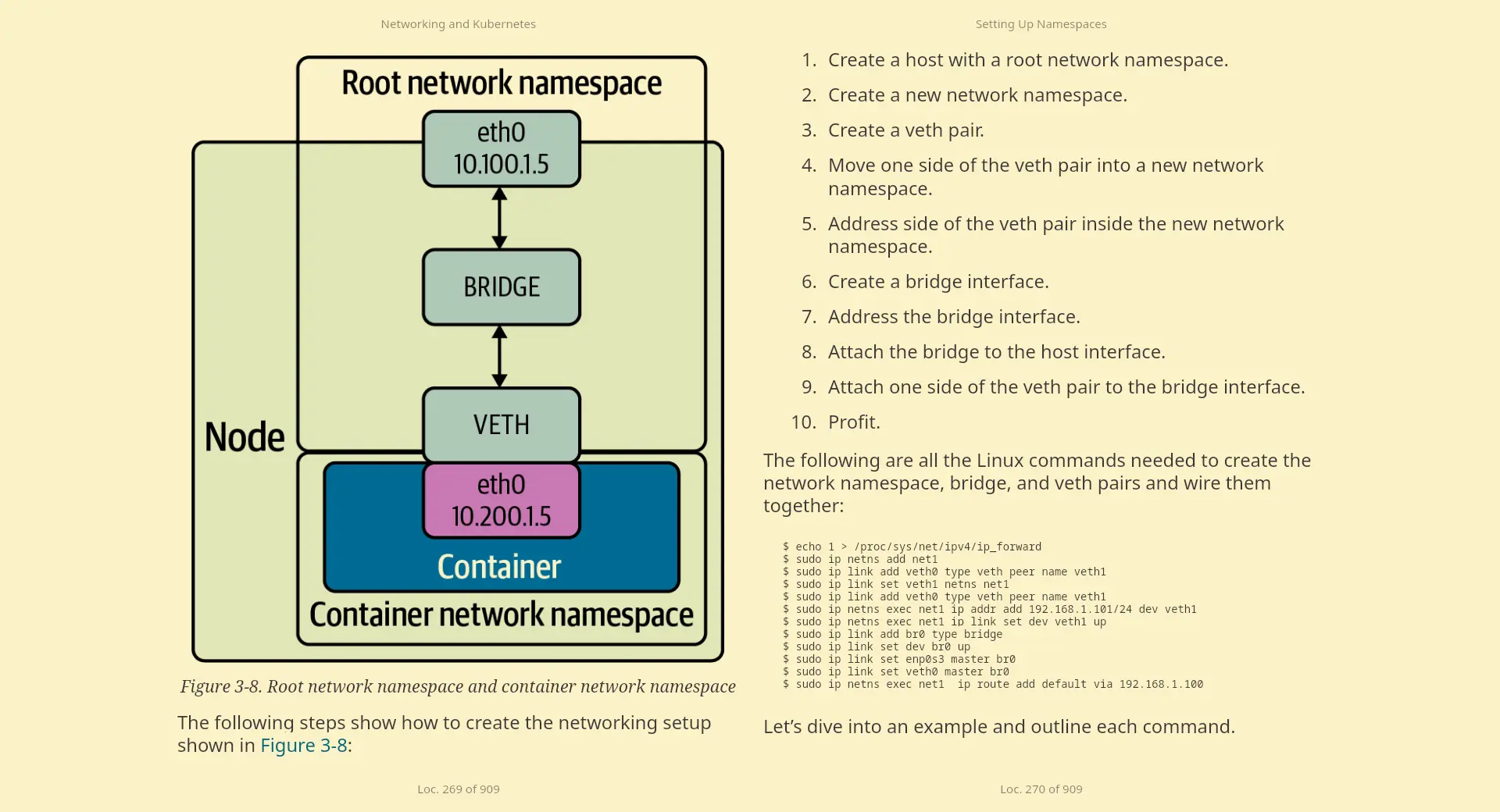
‘Root network namespace and container network namespace’
—James Strong and Vallery Lancey, “Networking and Kubernetes”