What are golden paths? A guide to streamlining developer workflows
Golden paths for engineering execution consistency | Google Cloud Blog
How to Build Golden Paths Your Developers Will Actually Use
Tldr
A golden path is a curated, self-service, opinionated set of tools, workflows, and templates that enables developers to deliver software quickly, securely, and consistently.
The platform team creates an opinionated, well-lit road. Teams can diverge from it, but following it is so easy that most don’t need to. The infrastructure complexity sits entirely below the platform — product teams never see Terraform or raw cloud APIs.
Introduction
Instead of every team making its own decisions about infrastructure, CI/CD, security, monitoring, and deployment, the platform team provides a standardized path that works well for most applications.
Simple analogy
Imagine a national park:
- The golden path is the paved trail with signs, lighting, and safety rails.
- You can leave the trail and take your own route if needed.
- But most visitors get to their destination faster and more safely by using the paved trail.
A Golden Path is a preconfigured, paved road that provides an end-to-end workflow for developers. It’s a predefined route that guides developers through common tasks, designed to reduce cognitive load and ensure that they can operate safely and in compliance. The concept of a golden path is also referred to as a “happy path” in software engineering. Golden paths are a key component of an Internal Developer Platform (IDPs).”
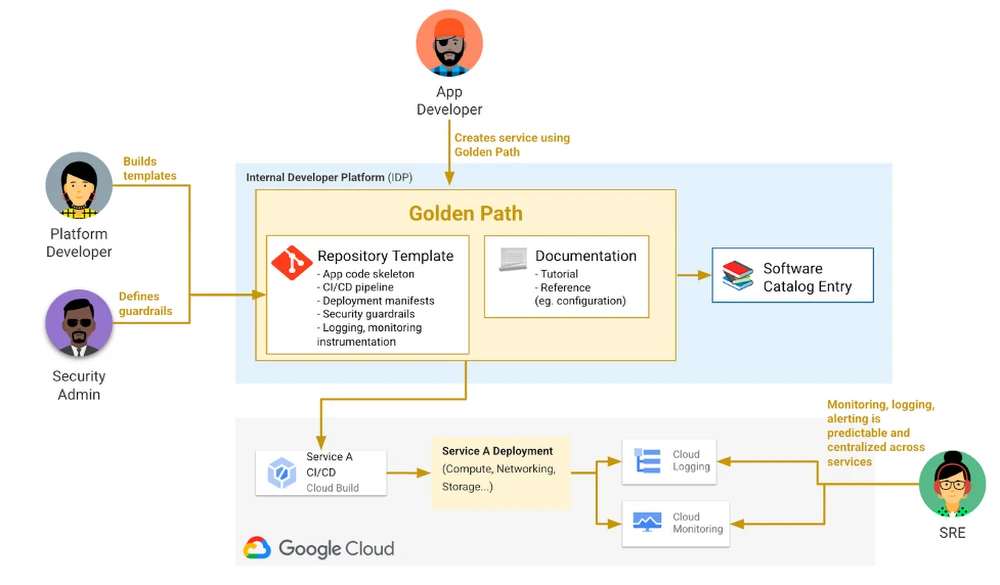
What a golden path typically includes
A platform team may provide:
- Project templates and scaffolding
- Standard CI/CD pipelines
- Kubernetes deployment patterns
- Security and compliance controls
- Logging and observability tools
- Infrastructure provisioning
- Documentation and examples
- Self-service developer portals
For example, a developer might run: create-service my-api
and automatically receive:
- Source repository
- CI/CD pipeline
- Monitoring dashboards
- Security scanning
- Kubernetes deployment configuration
- Standard documentation
without having to learn all the underlying platform details.
Why Organizations create golden paths
Faster developer onboarding
New engineers can become productive quickly because they follow established patterns.
Consistency
Applications are built and operated in similar ways across teams.
Better security
Security controls are built into the path rather than added later.
Reduced cognitive load
Developers focus on business features instead of infrastructure decisions.
Operational reliability
Applications inherit proven deployment and monitoring practices.
Golden path vs. Platform
Platform Engineering → builds the Platform → which offers Golden Paths to developers.
| Term | Meaning | |
|---|---|---|
| Platform Engineering | The discipline of building internal platforms for developers | |
| Internal Developer Platform (IDPs) | Internal Developer Platform (IDPs) | The tools and services provided by the platform team |
| Golden Path | The recommended workflow and standards developers follow when using the platform |
Examples of Golden Paths
Golden paths can be applied to various aspects of the software development lifecycle. Here are some examples:
- Provisioning a database: A developer can request a database, such as Postgres, through a UI or code-based interface, without needing to worry about the underlying configurations.
- Scaffolding a new service: This involves setting up the initial structure of a new application. A golden path here might involve multiple teams such as developers, security, and operations.
- Automated environment progression: This is where the deployment process between environments (development, staging, production) is automated. A git push, for example, can trigger automated policy checks and sign-offs.
- Updating app configurations: A golden path would allow developers to modify environment variables quickly and easily.
- Adding services and dependencies: A streamlined way for developers to add and manage the services and other dependencies required for their applications.
- Spinning up ephemeral environments: Developers can quickly spin up temporary environments through a golden path. For example, a simple Git push can trigger the creation of a new environment.
- Adding an S3 bucket: Developers can add an S3 bucket to an existing workload with just a couple lines of code.
- Understanding the difference between deploy A and B, then roll back: This path simplifies the process of comparing two deployments and allows developers to roll back with one click.
- Running policy checks and security sign-offs: A golden path would enable the integration of automated policy checks and human security sign-offs into the deployment process.