devops platformengineering sitereliabilityengineering devops/observability
DevOps vs SRE vs Platform Engineer | Which One You Should Choose in 2026?
Key Takeaways
DevOps remains a core culture and operating philosophy focused on collaboration and continuous delivery, though treating it purely as a job title has historically led to massive developer cognitive overload.
SRE (Site Reliability Engineering) is the concrete, software-engineering-driven implementation of operations focused on production reliability, utilizing quantitative metrics like SLIs, SLOs, and Error Budgets.
Platform Engineering is the modern scaling layer that designs and maintains Internal Developer Platforms (IDPs), offering “Golden Paths” that enable self-service delivery while abstracting infrastructure complexity.
The 2026 Paradigm: DevOps is the philosophy, SRE is the guardian of production, and Platform Engineering is the enabler of developer velocity.
Career Alignment: Choose DevOps if you excel at pipeline automation and release management; choose SRE if you love crisis management, deep systems debugging, and performance scaling; choose Platform Engineering if you want to build internal products and developer tools.
1. What is Platform Engineering
Internal Developer Platform (IDPs)
1. The Cognitive Load Crisis (Why This Debate Matters)
In the early cloud-native era, the industry rushed to adopt Werner Vogels’ famous mantra:
“You build it, you run it.”
— Werner Vogels, CTO of Amazon (2006)
While this shattered organizational silos, it introduced a major bottleneck by 2026: Developer Cognitive Overload. Instead of writing business logic, developers were forced to become experts in Kubernetes, Terraform, IAM, VPCs, DNS, monitoring, and compliance. This led to “shadow ops” and burnout.
Modern engineering organizations have realized that forcing every developer to be an infrastructure expert is a recipe for disaster. This realization paved the way for specialized, complementary practices.
2. Deep Dive: The Three Pillars
A. DevOps (The Cultural Foundation)
DevOps is an organizational mindset designed to bridge the historical gap between software developers and IT operations.
- Core Focus: Speed, automation, shared feedback loops, and agility.
- Key Practices: Continuous Integration (CI), Continuous Deployment (CD), Infrastructure as Code (IaC), and automated testing.
- Primary Metrics (DORA):
- Deployment Frequency: How often code is successfully deployed to production.
- Lead Time for Changes: The time it takes for a commit to reach production.
- Change Failure Rate: The percentage of deployments causing a failure in production.
- Failed Deployment Recovery Time (MTTR): How long it takes to restore service after an outage.
B. Site Reliability Engineering (The Control Layer)
Site Reliability Engineering (SRE) is what happens when you ask a software engineer to design an operations function. Introduced by Google, it is the concrete implementation of DevOps focused strictly on system reliability and performance.
- Core Focus: Uptime, availability, incident response, and performance at scale.
- Key Practices: Proactive automation, post-mortems, capacity planning, and monitoring.
- Reliability Metrics:
- Service Level Indicator (SLI): A direct quantitative measure of service performance.
- Service Level Objective (SLO): The target reliability target agreed upon by stakeholders (e.g., availability).
- Error Budget: The acceptable margin of failure. It governs whether the team can ship new features or must focus strictly on reliability. If an application has an SLO of , the Error Budget is . If this budget is exhausted, releases are frozen until stability is restored.
- Service Level Indicator (SLI): A direct quantitative measure of service performance.
C. Platform Engineering (The Scaling & Enablement Layer)
Platform Engineering is the discipline of designing, building, and maintaining Internal Developer Platforms (IDPs) to deliver self-service capabilities with automated guardrails.
- Core Focus: Developer Experience (DevEx), reducing cognitive load, and organizational scaling.
- Key Practices: Building portals (e.g., Backstage), Infrastructure-as-a-Service templates, and standardization.
- Golden Paths vs. Golden Cages:
- Golden Path: A pre-packaged, fully supported, and highly automated route to production that developers can opt into for frictionless delivery.
- Golden Cage: A restrictive, inflexible set of rules that prevents developers from innovating when their use case deviates from standard templates. Great platform teams build paths, not cages.
Golden Path in Platform Engineering
Internal Developer Platform (IDPs)
Backstage
3. The Great Kitchen Analogy
To easily conceptualize how these three roles interact, think of a busy, high-end restaurant:
┌────────────────────────────────────────────────────────────────────────┐
│                          THE RESTAURANT ANALOGY                        │
├───────────────────┬────────────────────────────────────────────────────┤
│ Role              │ Analogous Component                                │
├───────────────────┼────────────────────────────────────────────────────┤
│ Developer         │ The Chef: Focuses entirely on crafting amazing,    │
│                   │ high-quality dishes (business/application logic).  │
├───────────────────┼────────────────────────────────────────────────────┤
│ DevOps            │ The Kitchen Agreement: The collaborative guidelines│
│                   │ on how the staff communicates and hands off plates │
│                   │ safely from prep to the customer (culture/CI-CD).  │
├───────────────────┼────────────────────────────────────────────────────┤
│ Platform Engineer │ The Kitchen Designer: Builds the state-of-the-art  │
│                   │ workstations, stocks the pantry, and automates gas │
│                   │ lines and ovens (reusable developer portals/IDPs). │
├───────────────────┼────────────────────────────────────────────────────┤
│ SRE               │ The Health & Safety Officer: Monitors gas pressures,│
│                   │ food temperatures, and ensures the restaurant meets │
│                   │ SLAs without burning the building down (production).│
└───────────────────┴────────────────────────────────────────────────────┘
4. Architectural Relationship and Workflow
Modern high-performance engineering organizations do not choose one over the other—they integrate them.
graph TD
    %% Define Styles
    style Dev fill:#d4edda,stroke:#28a745,stroke-width:2px;
    style IDP fill:#cce5ff,stroke:#007bff,stroke-width:2px;
    style PE fill:#fff3cd,stroke:#ffc107,stroke-width:2px;
    style SRE fill:#f8d7da,stroke:#dc3545,stroke-width:2px;
    style Prod fill:#e2e3e5,stroke:#383d41,stroke-width:2px;

    %% Workflow Nodes
    PE[Platform Eng Team] -->|Designs & Builds| IDP[Internal Developer Platform / IDP]

    Dev[Application Developer] -->|Self-Services Infrastructure via| IDP
    Dev -->|Pushes Code| IDP

    IDP -->|Automated Deployment| Prod[(Production System)]

    SRE[SRE Team] -->|Monitors & Safeguards| Prod
    SRE -->|Enforces SLOs & Error Budgets| Dev
    SRE -->|Provides Reliability Templates| PE

    subgraph DevOps Culture
        PE
        Dev
        SRE
    end
5. Key Differences: 2026 Comparison
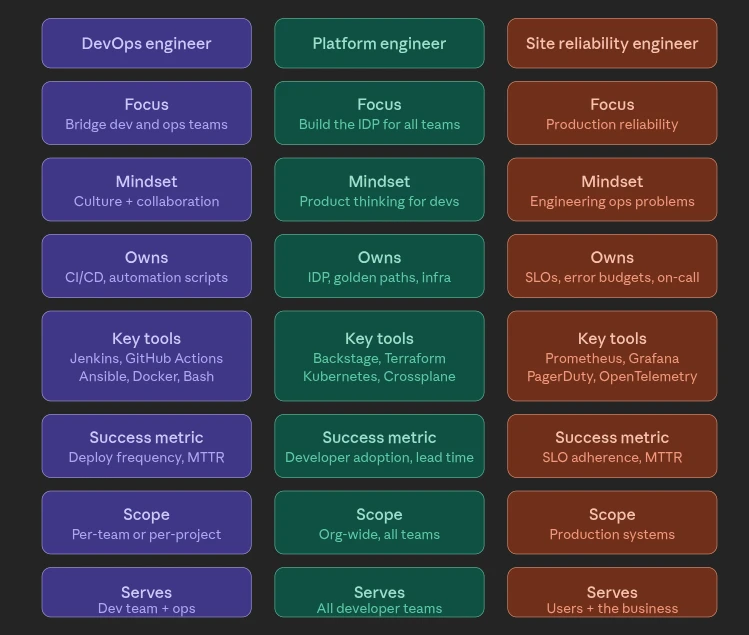
| Feature | DevOps (Mindset/Philosophy) | Site Reliability Engineer (SRE) | Platform Engineer (Product Model) |
| Primary Goal | Streamline collaboration and automate delivery pipelines. | Ensure production reliability, availability, and scale. | Optimize developer experience and scale operations. |
| Core Mentality | ”Break silos and automate everything." | "Treat operations as a software engineering problem." | "Build the platform as an internal product for developers.” |
| Operational Focus | Code Delivery (CI/CD, IaC, Testing). | Production Stability (Incident mitigation, On-Call, SLOs). | Self-Service Portals (Templates, IDPs, API abstractions). |
| Tooling Ecosystem | GitHub Actions, Jenkins, Ansible, Terraform. | Prometheus, Grafana, OpenTelemetry, PagerDuty. | Backstage, ArgoCD, Crossplane, Kubernetes, Portal APIs. |
| Primary Customer | The delivery pipeline / product squads. | The end-user / customer experiencing the platform. | The internal application developers. |
6. Decision Framework: Which Role Should You Pursue?
"DevOps is the blueprint, SRE is the security system, and Platform Engineering is the foundation that holds the house together."
Choose DevOps if:
- You love working at the intersection of business, software development, and operations.
- You enjoy optimizing workflows, writing robust CI/CD pipelines, and establishing automation patterns.
- You want to advocate for organizational culture shift and cross-functional alignment.
Choose SRE if:
- You thrive under high-stakes environments, debugging complex system anomalies, and optimizing infrastructure kernels.
- You have a strong programming background but are fascinated by distributed systems, networking protocols, and systems performance.
- You are comfortable being on-call and managing production incidents scientifically.
Choose Platform Engineering if:
- You are passionate about developer productivity, internal UX, and writing tools.
- You want to build microservices, manage API abstractions, and create standardized blueprints for thousands of developers.
- You prefer structured, predictable software development cycles over continuous operational fire-fighting.