kubernetes kubernetes/kcna kubernetes/networking
‘Chapter 15. Service Meshes’
—Brendan Burns, “Kubernetes: Up & Running”
Core Idea
A service mesh puts a programmable network layer between microservices for mTLS encryption, traffic shaping, and observability, and it earns that cost only when the app actually needs it.
- Capabilities of a service mesh, then when and where meshes are used.
- How service meshes work under the hood, and criteria for choosing one.
- The note’s own tip flags the trade-off: value versus added complexity.
What is a Service Mesh?
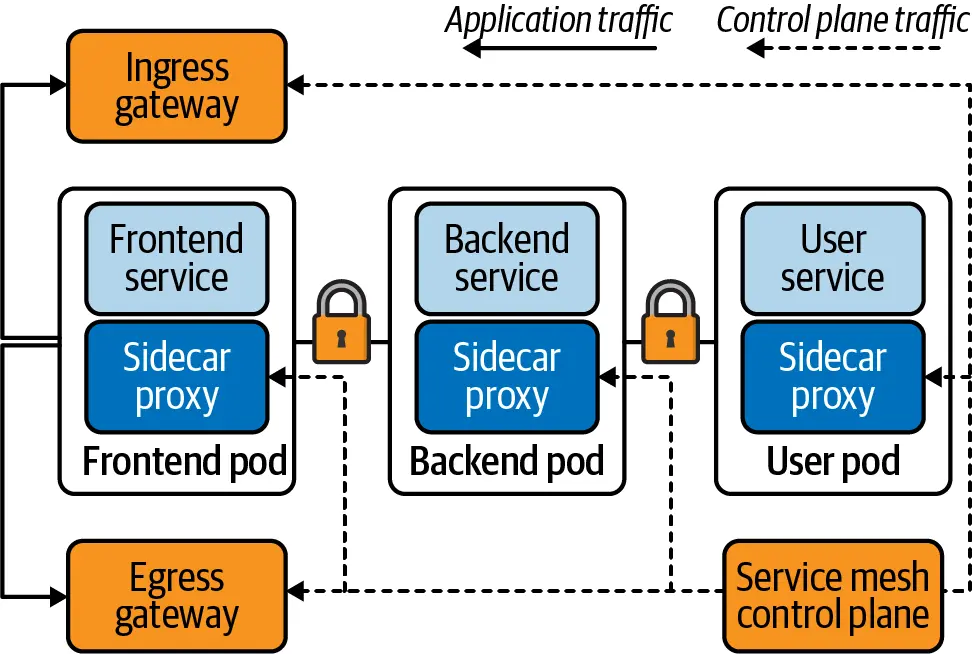
A service mesh is a technology used in cloud-native architectures to enhance networking capabilities between microservices. It provides functionalities like encryption (Mutual TLS (mTLS)), traffic shaping, and observability. While it adds value, incorporating a service mesh introduces complexity and requires careful consideration based on application needs
Capabilities of a Service Mesh
- Encryption and Authentication with mTLS:
- Secures communication between Pods by encrypting traffic and providing identity via client certificates.
- Automates encryption to avoid manual, error-prone implementations.
- Traffic Shaping:
- Enables routing requests to different service versions for experiments like A/B testing or feature rollouts.
- Declarative configurations simplify experimentation, increasing application reliability and agility.
- Observability:
- Provides request tracing across microservices, helping developers debug distributed systems.
- Ensures consistent monitoring across all services in the cluster.
- Service Discovery
- Instead of relying on DNS for service discovery, the service mesh manages service discovery, and removes the need for it to be implemented in each individual application.
- Service Discovery
Usage
- Pros: Enhanced security, flexibility, and monitoring for large, complex systems.
- Cons: Adds operational complexity, increases dependency risks, and can cause system-wide outages if it fails.
- When to Use: Ideal for large-scale systems or when managed service mesh options are available (e.g., from cloud providers).
- When to Avoid: For small applications or when Kubernetes’ native networking resources meet all needs.
How Service Meshes Work
- Sidecar Containers: Automatically added to Pods (via admission controllers) to handle network traffic and enforce policies.
- Custom Resource Definitions (CRDs): Extend Kubernetes with service mesh-specific capabilities like routing rules and access controls.
- Standardization: The Service Mesh Interface (SMI) aims to create vendor-neutral APIs.
Choosing a Service Mesh
- Popular Options: Istio, Linkerd, Consul Connect, Open Service Mesh, AWS App Mesh.
- Guidelines: Prefer managed service meshes from cloud providers to offload operational complexity.
- Caution: Avoid flashy demos; service mesh selection should align with application needs and long-term maintainability.
Service Mesh