Core Idea
Docker Swarm is Docker’s own orchestrator: form a cluster of Docker nodes and deploy services onto it, with far less machinery than Kubernetes.
- Orchestration context, then Swarm as the tool that creates and manages a cluster of Docker nodes.
- Coverage: Swarm versus Compose, features, architecture, and swarm mode key concepts.
- Comparisons: containers vs Swarm, Swarm vs Kubernetes, and service vs task.
What is container orchestration ?
Container orchestration automatically provisions, deploys,scales and manages containerized applications without worrying about the underlying infrastructure.
Docker Swarm is an orchestration management tool that runs on Docker applications. It helps end-users in creating and deploying a cluster of Docker nodes.
👉 07. Docker Compose, Swarm & Stack > Swarm
Docker Swarm vs Docker Compose
Key Difference
- Docker Compose is for orchestrating containers on a single machine.
- Docker Swarm is for orchestrating containers across multiple machines in a distributed environment.
| Feature | Docker Compose | Docker Swarm |
|---|---|---|
| Purpose | Used for defining and running multi-container Docker applications on a single host. | A native orchestration tool for managing and scaling containers across a cluster of nodes. |
| Scope | Local development and testing. | Production-grade container orchestration and deployment. |
| File Format | docker-compose.yml | Uses the same docker-compose.yml file, with additional swarm-specific commands. |
| Execution | Single-host; runs containers on a single Docker daemon. | Multi-host; orchestrates containers across a swarm of Docker nodes. |
| Scaling | Can scale services manually with the docker-compose up --scale command. | Supports automatic scaling, service replication, and load balancing. |
| Networking | Simple local networking (e.g., bridge network). | Uses an overlay network for communication between nodes in the swarm. |
| High Availability | Not inherently designed for high availability. | Provides high availability through service replication and leader election. |
| Built-In Features | Environment variable support, volume mounting, and simple configurations. | Advanced features like rolling updates, rollback, health checks, and more. |
| Setup Complexity | Easy to set up; ideal for local development. | More complex to set up but designed for production environments. |
| Node Management | N/A (Single-host). | Supports clustering with manager and worker nodes. |
| Use Case | Local development, CI/CD testing, and lightweight use cases. | Scalable, fault-tolerant deployments in production environments. |
Features
- Simple and Fast: The Swarm mode offers simplicity and speed for development and deployment.
- Decentralized access: Swarm makes it pretty easy for organizations to enter and manage the environment
- High security: The communication between the manager and a worker nodes is highly secure within the swarm
- Autoload balancing: We also have an autoload balancing option within your environment, and you can write your own script for this.
- High scalability: With load balancing comes high scalability.
- Roll-back: It also allows you to roll back environments to previous safe environments
Docker Swarm Architecture
- Manager Node : Carries out and oversees cluster-level duties.
- Worker node : Receives and completes the tasks set by the manager node.
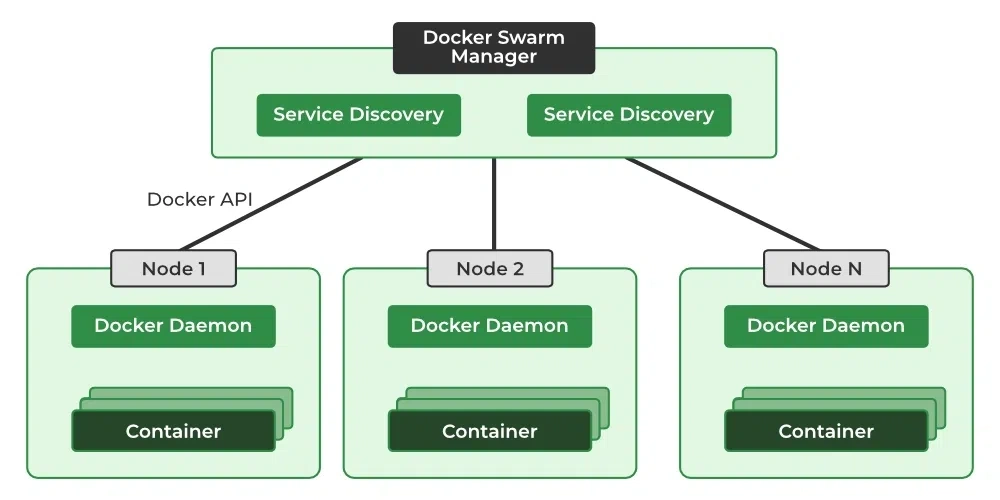
A single manager node can be created but the worker node can not be created without a manager node. The ideal number for the count of the manager node is seven. Increasing the number of the manager node does not mean that the scalability will increase.
Docker swarm mode key concept
- Node: A Node is an instance of a Docker engine that connects to the Swarm. You can run one or more nodes on a single physical computer or cloud server. Nodes can be either a manager or workers. The manager node dispatches units of work called tasks to worker nodes. Worker nodes receive and execute tasks dispatched from manager nodes.
- Services: A service is a high-level concept relating to a collection of tasks to be executed by workers. An example of a service is an HTTP Server running as a Docker Container on three nodes.
- Load Balancing: Docker includes a load balancer to process requests across all containers in the service.
Comparison
Docker Container vs Docker Swarm
| Docker Container | Docker Swarm |
|---|---|
| Docker Container is an executable package that consists of all the code and dependencies. | Docker Swarm is the container orchestration tool that manages all the containers available in the Swarm cluster. |
| The container can be run on any OS as Docker is an underlying runtime. | Docker Swarm will manage the cluster which consists of Docker nodes. |
| A single, isolated, and self-contained unit called a “Docker container” is capable of running an application. | You may manage many Docker containers across various servers in a cluster using the technology known as Docker Swarm. |
| Docker containers are more suitable for microservices applications than monolithic applications. | Docker Swarm will scale, deploy and balance the containers. |
Docker Swarm vs Kubernetes
| Kubernetes | Docker Swarm |
|---|---|
| Kubernetes is an open-source platform used for maintaining and deploying a group of containers | Docker Swarm is designed to be a simple and lightweight container orchestration. |
| In practice, Kubernetes is most commonly used alongside Docker for better control and implantation of containerized applications. | With Docker swarm, multiple containers run on the same hardware much more efficiently than the VM environment & productivity of Docker is extremely high. |
| Applications are deployed as a combination of pods, Deployment, and services. | Apps are deployed in the form of services. |
| It supports auto-scaling of the container in a cluster. With more efficient | Docker Swarm does support auto-scaling but is not as efficient as docker swarm. |
| The health check is of two kinds: liveness and readiness. | Health checks are limited to service. |
| Hard to set up and configure. | Docker swarm setup and installation are easy. |
| It does not have extensive documentation but is quite less than Docker Swarm. But it does include everything from installation to deployment. | Docker swarm documentation is more effective, more extensive, and has even more capabilities & it includes everything from installation to deployment & quick-start instructions as well as a more detailed tutorial. |
| Kubernetes installation is provided to be quite difficult than Docker swarm and even the command for Kubernetes is quite more complex than Docker swarm. | Docker swarm installation is quite easier, by using fewer commands you can install Docker in your virtual machine or even on the cloud. |
Docker Service vs Docker Task
| Aspect | Docker Service | Docker Task |
|---|---|---|
| Definition | A higher-level abstraction that defines how to run containers as a group | An individual instance of a container created by a service |
| Purpose | Manages the deployment and scaling of a group of containers | Executes a single unit of work within a service |
| Management | Handles orchestration, load balancing, and scaling | Represents the actual work being performed by a container |
| Scalability | Easily scaled up or down to manage load | Cannot be individually scaled; scaling is done at the service level |
| State | Desired state defined (e.g., number of replicas) | Current state of a specific container instance |
| Failure Handling | Automatically reschedules tasks if a container fails | Does not manage failures; relies on service for rescheduling |