systemdesign distributedsystem
Message Broker
Dead Letter Queue - System Design - GeeksforGeeks
Dead Letter Queue: How to Handle Failed Messages Gracefully - DEV Community
A Dead Letter Queue(DLQ) is a queue where messages that cannot be processed successfully are sent for further analysis and handling.
It acts as a fail-safe mechanism in message queue systems to prevent message loss and help debug issues.
- When a message cannot be delivered, it is redirected to the DLQ instead of being lost or endlessly retried.
Why Messages End up in a Dead Letter Queue?
Messages are moved to a DLQ due to several reasons, including:
- Message Processing Failures – The consumer fails to process the message after multiple retries.
- Message Expiration – The message exceeds its Time-To-Live (TTL) before being processed.
- Queue Overload – The main queue reaches its storage limit.
- Incorrect Message Format – The message is malformed or contains invalid data.
- Authentication or Authorization Issues – The consumer lacks permissions to process the message.
How It Works
- The messaging system detects failed messages based on pre-configured policies (like max retries or TTL).
- The failed message is redirected to the DLQ instead of being lost.
- Engineers or automated processes analyze the messages in the DLQ to identify and fix the root cause.
- The messages may be manually reprocessed or routed back to the main queue after resolution.
Message Life Cycle in DLQ
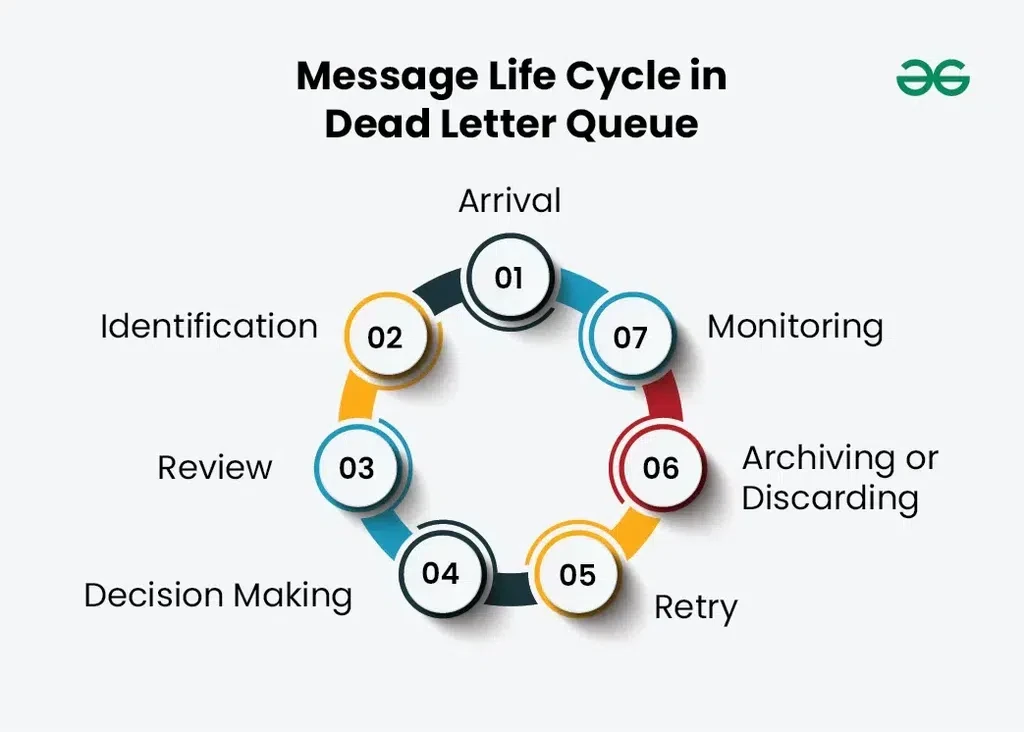
- Arrival:* The message enters the DLQ after failing to be processed in the primary queue.
- Identification: System operators or automated processes identify and categorize the error that caused the failure.
- Review: The message is examined to determine whether the issue is transient or persistent.
- Decision Making: A decision is made on whether to retry, discard, or escalate the message based on its importance and error nature.
- *Retry: If applicable, the message is modified if necessary and resent to the primary queue for reprocessing.
- Archiving or Discarding: Messages that cannot be reprocessed or are no longer relevant are either archived for record-keeping or discarded safely.
- Monitoring: Throughout its stay in the DLQ, the message and its handling are monitored to ensure compliance and audit requirements are met.
Tools
Using dead-letter queues in Amazon SQS - Amazon Simple Queue Service
Dead Letter Exchanges | RabbitMQ
- Amazon SQS – Supports DLQ with message redrive policies.
- RabbitMQ – Uses dead-letter exchanges (DLX) to route failed messages.
- Apache Kafka – Uses a separate topic for dead-letter messages.
- ActiveMQ – Has built-in support for DLQs.
- Google Pub/Sub – Supports DLQs for handling undeliverable messages.
Redis itself doesn’t have built-in DLQ support like message brokers (e.g., RabbitMQ, Kafka).