books booknotes productivity psychology
Tldr
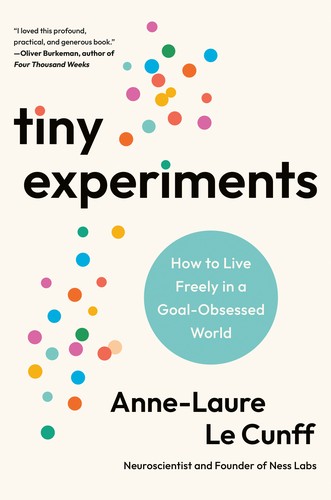
Anne-Laure Le Cunff — Tiny Experiments: How to Live Freely in a Goal-Obsessed World
Profile Books / Penguin, 2025 · 304 pages · ISBN 9781800819153
A guide to replacing big borrowed goals with small experiments. Curiosity generates hypotheses, daily life becomes the laboratory, and progress comes from incremental experimentation rather than rigid plans.
Curiosity and imagination
- Don’t let anyone rob you of your imagination, your creativity, or your curiosity.
- American psychiatrist Irvin Yalom wrote about awakening experiences, events that shake us from default routines, crack our defensive barriers, and open new possibilities.
- How was life, really? I hadn’t ever asked myself this. I was too busy, always focused on finishing the next deliverable or hitting a bigger target.
- We get hired to provide answers based on our expertise, not questions based on our curiosity.
- More than two thousand years ago: “Let all your efforts be directed to something, let it keep that end in view.”
- Epictetus saw goal setting as a matter of clarity and determination: “First say to yourself what you would be, and then do what you have to do.”
Borrowed goals
- Because of social media, we compare ourselves to our peers more than ever.
- Our goals are often not even our own; we borrow them from peers, celebrities, and what we imagine society expects from us.
- This is mimetic desire.
- Toxic productivity leads to burnout, creating ups and downs. Working in isolation means we lack the support networks to help smooth the way.
The in-between and uncertainty
- Our brain is uncomfortable in the in-betweens. We are wired to quickly label situations as good or bad, an evolutionary mechanism designed to protect us from unknown risks. Safe or not? Friend or foe? Secret passage or dead end? However, this instinct can become problematic when a clear answer isn’t readily available.
- At that point, we tend to fall back on one of three defense mechanisms, where we abandon our curiosity, our ambition, or both.
- These are not personality types. Rather, they’re shields we raise in the face of uncertainty.
- One shield is compensatory control. Our first instinct is to remove the stressor. When we can’t, we urgently seek activities that restore our sense of control, anything to compensate for our helplessness.
- Response 1 is automatic and rooted in the anxiety of uncertainty. Response 2 is autonomous and based on a strong sense of agency.
Tiny experiments
- Progress is driven by incremental experimentation.
- The first step is to rekindle your curiosity to imagine new possibilities.
- Watch for information overload.
- Once you have a hypothesis, you can design an experiment and turn your life into a giant laboratory for self-discovery.
- The more you do, the more you fail. The more you fail, the more you learn. The more you learn, the better you get.
- A pact is not a habit.
Energy and mood
- Stress isn’t always bad for us. In fact, a certain degree of stress, known as eustress, which means “good stress” in Greek, can boost performance.
- It doesn’t need to be a full-on stretching session. You don’t even have to get up if you can’t. You just need a few fluid movements. You could slowly roll your shoulders up and down or subtly shift your weight from side to side while standing, stretching the muscles in your legs and hips. Even small movements such as rotating your wrists or ankles can stimulate your parasympathetic nervous system. Pay attention to the sensations in your stomach, your lungs, your heart. What’s important is to focus on the inner experience of the movement instead of what it looks like from the outside.
- For your emotional resources, practice conscious movement whenever you notice any signals of distress.
- Executive function: Avoid multitasking.
- Look for an action that can quickly shift your mood, such as music or scent; reconnect you to your body, such as stretching or conscious breathing; or give you the chance to check in with yourself, such as making a handwritten list of your intentions for the rest of your workday.
Procrastination
- That arrow is not the procrastination itself; it’s your emotional reaction to it.
- Tim Pychyl’s work frames the same idea.
- I pulled my field notes and started actively capturing observations about my responses whenever I opened the document.
Selected highlights
“Don’t let anyone rob you of your imagination, your creativity, or your curiosity.”
“Our goals are often not even our own; we borrow them from peers, celebrities, and what we imagine society expects from us.”
“The more you do, the more you fail. The more you fail, the more you learn.”
“A pact is not a habit.”