books booknotes technology history biography
Tldr
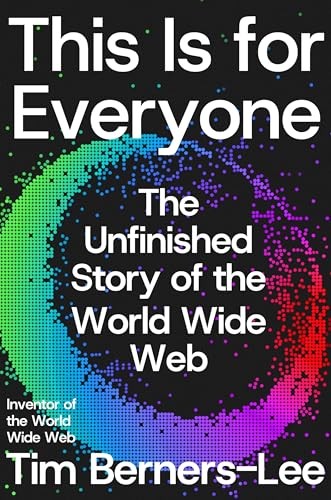
Tim Berners-Lee — This Is for Everyone: The Unfinished Story of the World Wide Web
with Stephen Witt · Farrar, Straus and Giroux, 2025 · 400 pages · ISBN 9780374612463
The inventor of the web’s memoir: how a document-linking idea at CERN became the World Wide Web — told with the technical detail of the protocols themselves (HTTP, HTML, DNS, those infamous slashes) and the principle that made it work: the web had to be free.
Origins
- Born in 1955, the same year as Steve Jobs and Bill Gates.
- Emanuel was, alas, a boys-only institution, which must have delayed my social development immeasurably.
- On the 2012 film adaptation of The Imitation Game: subjected it to a rather withering fact-check, complaining both about the whitewashing of Turing’s sexuality and the inaccurate representation of certain beloved wartime computing machines.
- The Apollo engineers used transistors to guide Neil Armstrong and Buzz Aldrin to the surface of the moon. Even now, transistors form the basis of all computing — they have just got smaller and smaller and smaller.
The internet before the web
- TCP/IP (Transmission Control Protocol + Internet Protocol), developed by Vint Cerf and Bob Kahn — later met both.
- The US Department of Defense adopted IP addressing in 1981, making it the first early major user. For this reason, within CERN there was initially some consternation about TCP/IP — many Europeans associated it with the Pentagon, which was vilified in Europe at that time.
- Several voices at CERN wanted to use OSI (Open Systems Interconnection), standardized by ISO in Geneva — the body that standardized global shipping containers. In Europe there was a strong political push for ISO protocols. The major disadvantage: it would create two separate systems that didn’t speak the same native language.
- Email was the internet’s first killer app.
The hypertext lineage
- The terms ‘hypertext’ and ‘hypermedia’ were coined as part of an ambitious computing platform termed Project Xanadu.
- In 1968 the visionary Douglas Engelbart gave a ninety-minute presentation at the San Francisco Civic Auditorium — now called ‘The Mother of All Demos’.
- Early hypertext pioneers were building a document-linking system — but they hadn’t imagined that hyperlinks should jump beyond documents into any computer, anywhere in the world.
Building the web
Inventions and accidents
- HTML: early markup was crude (writing ‘.bold’ on a new line for bold, for example), but by 1990 people were used to early word processors like MacWrite or WordStar, which showed formatted text immediately as you wrote — ‘What You See Is What You Get’ editors, or WYSIWYG.
- HTTP error codes: a set of numbered error conditions copied from other protocols. 400-level meant the user had done something wrong; 500-level meant the problem was on the server side. The most famous of these is error 404.
- The double slash: using the rather obscure Apollo naming system meant placing the two slash characters ’//’ between the http protocol specification and the DNS address. The idea was that when linking two websites you could skip ‘http:’ and start with ’//’ — but in practice people don’t.
A design apology
So I could have designed the web without the double slash, and that would have led, over three decades, to quite a lot of saved keystrokes. Sorry!
The web stays free
The founding decision
The only way forward, I realized, was to donate the intellectual property behind the web to the public domain. I had never intended to profit personally from the technical protocols I’d written for the web, so this decision didn’t impact me — and it didn’t matter. For the web to succeed, it had to be free.
- Vint Cerf had similarly licensed his TCP/IP protocol for eternal, free public domain use, with no restrictions.
- The World Wide Web Organization (W3O) later became the World Wide Web Consortium (W3C), as it is known today.
Early page authors
Early web page authors could be quite creative. When they worried…
Selected highlights
“For the web to succeed, it had to be free.”
“The hypertext pioneers hadn’t imagined that hyperlinks should jump beyond documents into any computer, anywhere in the world.”
“Email was the internet’s first killer app.”