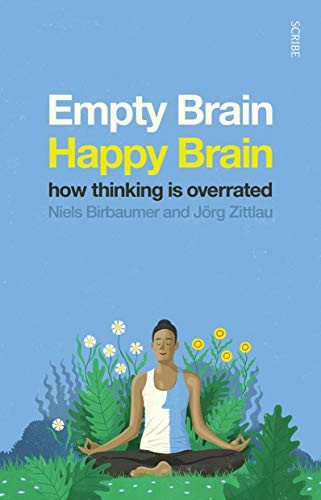
Niels Birbaumer & Jörg Zittlau — Thinking Is Overrated: Empty Brain — Happy Brain
Translated by David Shaw · Scribe Publications, 2018 · 272 pages · ISBN 9781925322507
1. Introduction: A Parachute Jump into Emptiness
The journey into the neurobiology of emptiness begins not in a laboratory, but in the sky. During a parachute jump intended to test wireless physiological monitoring, the author experienced a profound shift in consciousness. Initially, the brain acted as a hyper-active “thought pump”—a term coined by Valentino Braitenberg to describe the organ’s relentless drive to draw thoughts from the depths. As the hatch opened, this pump went into “hyperactive collapse.” Like a shipwrecked sailor desperately trying to bail out a leaking lifeboat with an empty yogurt pot, the author’s executive mind could only produce fragments of terror as his mouth turned into a desert.
However, the moment of the jump triggered a state of “rapture.” The “self” seemed to vanish, replaced by a blurred boundary between the individual and the world. This near-death experience temporarily disabled the brain’s executive mechanisms, creating a state of “positive emptiness” where day-to-day worries were swept away. This phenomenon challenges the foundational Western philosophical tenet of René Descartes: Cogito ergo sum (I think, therefore I am). If our existence is defined by thought, what remains when the thought pump stops? The evidence suggests that what remains is not “nothing,” but a state of being that is wonderfully, peacefully empty—a state that modern society, with its pathological fear of boredom, seems designed to prevent.
2. Chapter 1: There’s Always Something—The Banishment of Emptiness
Modern Western culture is characterized by an “experience society” that views the gathering of stimuli as an existential ideal. This is humorously illustrated by the “Loriot” sketch, where a wife is distressed by her husband simply “sitting there” doing nothing. We have developed an inability to endure nothingness, viewing boredom with a fear comparable to that of cancer. We are victims of a “catastrophic brain”—an evolutionary artifact that once looked for sabre-toothed tigers and now perceives the same level of existential threat in a pinging smartphone or a disconnected internet.
The Modern Distraction Landscape
- Media Saturation: In Germany, over-50s watch nearly five hours of TV daily, while younger generations engage in “media multitasking,” a frenzied state that prevents any singular experience from taking root.
- The Smartphone Priority: Surveys by Forsa and Yahoo indicate that 60–70% of young people would rather go without sex for a week than surrender their smartphones.
- Channel-Hopper Mentality: Variety has been raised to a principle. By constantly seeking the “next” stimulus, we rob experiences of longevity, resulting in a “permanent increase in appetite” but zero satiety.
The Wilson Experiment (University of Virginia)
Timothy Wilson’s research highlights the physical aversion to quiet thought. Subjects were asked to sit in a room for 15 minutes with no distractions.
- Results:
- 67% of men chose to self-administer an unpleasant 9-volt electric shock rather than sit in silence.
- 25% of women chose the shock.
- The “Results Society” & Dopamine: This is not mere restlessness; it is the mesolimbic dopamine system in action. The brain “wants” effects. Because the release of dopamine triggers the urge to achieve a goal, the brain perceives a painful stimulus as a “reward” or a successful “result” compared to the agonizing vacuum of emptiness.
Having established the sociological hunger for constant stimulation, we must look to the philosophers who first identified the “dictatorship of the will” and sought a way out.
3. Chapter 2: Free at Last—Philosophers as Pioneers
Philosophers have long recognized the brain’s constant wanting as a source of slavery. To find freedom, they sought “salvation through emptiness.”
Philosophical Comparative Analysis
- Heraclitus: Introduced panta rhei (everything flows). He favored “emptiness rather than education,” believing that much learning prevents true understanding. He retreated to solitude to seek a sense of emptiness that language could not describe.
- Buddha: Identified the “thirst for life” as the source of suffering. He proposed extinguishing the will like a campfire to reach Nirvana—a state of unconditional emptiness where the illusory “self” finally dissolves.
- Schopenhauer: Viewed the will as a “vale of tears.” He saw music as the “echo of the will,” a vehicle for self-loss where our individual moods merge with the music, allowing the ego to retreat.
- Nietzsche: Propounded the “Dionysian” intoxication of emptiness. He celebrated the “delight in destruction” found in total self-forgetfulness, though he warned of the “giddiness” felt by the tightrope walker who leaves reason behind.
- Cioran: An insomniac who viewed the “ecstasy of capitulation” as the ultimate peace. He believed the second half of a sleepless night breaks all certainties, leading to a dulling of the mind that is more liberating than regenerative sleep.
The Pathology of Nietzsche: While historically attributed to syphilis, researcher Leonard Sax has refuted this. Nietzsche lacked the expressionless face and tongue tremors of syphilis. Crucially, Sax points to the asymmetry of Nietzsche’s pupils, a condition present since the philosopher’s childhood, which contradicts the neurosyphilis hypothesis. Nietzsche’s final years were not a “burnout” but a “dreamy” and “tranquil” state—he had finally achieved the “child of the heart” status his philosophy demanded.
Having established the philosophical hunger for emptiness, we must now look at the electrical gatekeeper that either permits or denies this state: the Thalamus.
4. Chapter 3: Marching in Slow Step—The Brainwaves of Emptiness
The neuro-electrical basis of consciousness relies on neuronal synchronization. When neurons fire in “lockstep,” they create wave patterns that act as the conductor for the brain’s state.
The Thalamus and ARAS
The Thalamus functions as the “gateway to the conscious mind” and the “gateway to emptiness.” It filters sensory stimuli using inhibitory interneurons to close the gate. This gate is controlled by the Ascending Reticular Activating System (ARAS), a column of cells in the midbrain that determines the “firing rate” of the brain. When the ARAS provides high-level activation, we are alert; when the Thalamus uses its inhibitory interneurons to block these signals, the cortex can finally go quiet.
Brainwave Typology
| Wave Type | Frequency (Hz) | Mental State/Context |
| Beta/Gamma | 13–100 | Active concentration, tension, or high-level Zen meditation. |
| Alpha | 8–12 | Relaxed waking state, equilibrium, “warm bath” state. |
| Theta | 3.5–7 | Twilight state, sleepiness, or hippocampal spatial perception. |
| Delta | 0.5–3.5 | Deep sleep, comas, or pathological unconsciousness. |
Rhythmical Synchrony: “Positive emptiness” is not defined by low frequency alone, but by high-amplitude synchrony. This “marching in step” (1–4 Hz) is the common signature of military parades, chanting, and orgasms. These states represent a temporary synchronization where cognitive alertness fades into a powerful, rhythmic background, allowing the self to be swept away.
5. Chapter 4: Beyond the Defense Mechanism—The Brain Areas of Emptiness
The human brain is a calorie-guzzling mini-colossus evolved to compensate for physical weakness. This “defective creature” survival strategy created a brain on high alert.
Key Anatomical Regions
- The Amygdala and Fear: Processes data via the “Quick and Dirty” (thalamus-direct) or “High Road” (cortical analysis) paths. A study of an Iowa woman with destroyed amygdalae showed she was “senselessly happy” but unable to feel fear even with snakes or in haunted houses.
- The Insula and Proprioception: The right posterior insula is the hub for body awareness. If hyperactive, it triggers intense pain or phobias, such as “math phobia,” where the brain reacts to an equation as if a limb were physically broken.
- The Reward Center: The Nucleus Accumbens and Basal Ganglia drive motivation. There is an antagonism between the defense (fear) system and the reward system. When the defense system rests, the state of emptiness itself is perceived as a profound reward.
While these areas manage our active defenses, we must also consider the “autopilot” network that activates when we are seemingly doing nothing.
6. Chapter 5: Default-Mode Network—The Brain on Autopilot
In 1928, Alexander Fleming discovered penicillin by accident; similarly, Marcus Raichle discovered the Default-Mode Network (DMN) while testing brain scanners. He found that the brain is never truly “off”; it simply switches to a strategic “offline” processing mode.
Map of the DMN
The DMN activates the Cingulate Gyrus, Parietal Lobes, Hippocampus, and Medial Prefrontal Cortex. These regions act as an “offline defragmenter,” reordering data and re-evaluating memories to prepare for future tasks.
Mind-Wandering vs. Emptiness
- The Happiness Gap: Humans spend 47% of their lives mind-wandering. This “grasshopper mind” often leads to unhappiness because it circles self-referential problems.
- IQ and Complexity: Using nonlinear dynamics (chaos theory), researchers found that highly intelligent individuals show much higher “thought complexity” and less predictability in their DMN activity than less intelligent individuals. True emptiness requires moving away from this complexity toward a simpler, synchronized state.
This “noisy” DMN is precisely what clinical isolation and sensory deprivation seek to silence.
7. Chapter 6: Senselessly Happy—The Reality of Sensory Deprivation
Historically, humans suffered from Taphephobia (fear of being buried alive). Modern science, however, has repurposed isolation into REST (Restricted Environmental Stimulation Therapy).
Hebb vs. Suedfeld
Donald Hebb’s 1950s experiments failed (100% dropout) because subjects were terrified by “panic buttons” and liability waivers. Peter Suedfeld’s “REST” achieved a 95% success rate by rebranding the experience as a safe, “twilight” relaxation tool.
The Disappearing Self
The case of Ian Waterman reveals the stakes of our “sixth sense.” A virus destroyed his muscle spindles (stretch receptors) and Golgi organs (tension receptors). Without these signals, Ian initially felt he “didn’t exist” whenever he closed his eyes. The Rubber Hand Illusion further proves that our body image is a construct of the right posterior insula; by detaching from these proprioceptive signals—either through illness or a floatation tank—the boundary between the self and the world dissolves.
8. Chapter 7: Training for Emptiness—Neurofeedback and Zen
Can we train the brain to deactivate its own executive networks?
- Neurofeedback and the Insula: Researchers in Tübingen used fMRI “thermometers” to help subjects modulate their anterior insulae. This proved the brain can be trained to “turn down” its response to stimuli, even in psychopaths or OCD patients.
- The Mechanics of Zen: The lotus position is a biological hack; it stretches muscles to mute proprioceptive signaling. Kōans (logical riddles) are designed to break the “thought pump” of rational reasoning.
- Neurological Detachment: fMRI scans of Asian Zen monks show a literal detachment of the anterior (executive/meaning) regions from the posterior (sensory) regions. The monks perceive the world intensely, but the brain assigns it no meaning. Conversely, neurologist James Austin failed this in the lab because his “goal-oriented” Western mindset (the desire to prove his theories) kept his executive network active.
9. Chapter 8: Lusting for Emptiness—Sex, Religion, and Epilepsy
There is an evolutionary advantage to “self-forgetfulness.” For a species to reproduce, the brain had to evolve a “positive experience of self-loss” to facilitate moving from “I” to “We.”
Lust and Intelligence
The “Love is Blind” study found that when students thought about their partners, their brainwave complexity took a radical dive. Their heads were “full of nothing” but the loved one, shifting the brain toward a simpler, predictable electrical state.
The Toothbrush Orgasm
In Taiwan, a woman named Emily found a unique path to emptiness. After a hysterectomy, her brain repurposed the mundane, rhythmical routine of brushing her teeth into a trigger for sexual climax. This proves the brain can find highly unconventional, rhythmical paths to deactivate the self.
Evolutionary Hypothesis
Newberg and d’Aquili theorize that religious mysticism is an evolutionary by-product of the biological necessity for self-loss during mating. The language of the mystic (ecstasy, devotion) is the language of the lover.
Final Summary
Achieving “positive emptiness” is not an act of “doing,” but the result of complete surrender and trust. Whether through music, meditation, or clinical isolation, emptiness only occurs when the “will to achieve” is banished. To enter the void, one must be willing to let go of the self entirely, moving from the complexity of thought to the simple, high-amplitude rhythm of the absolute.