Tldr
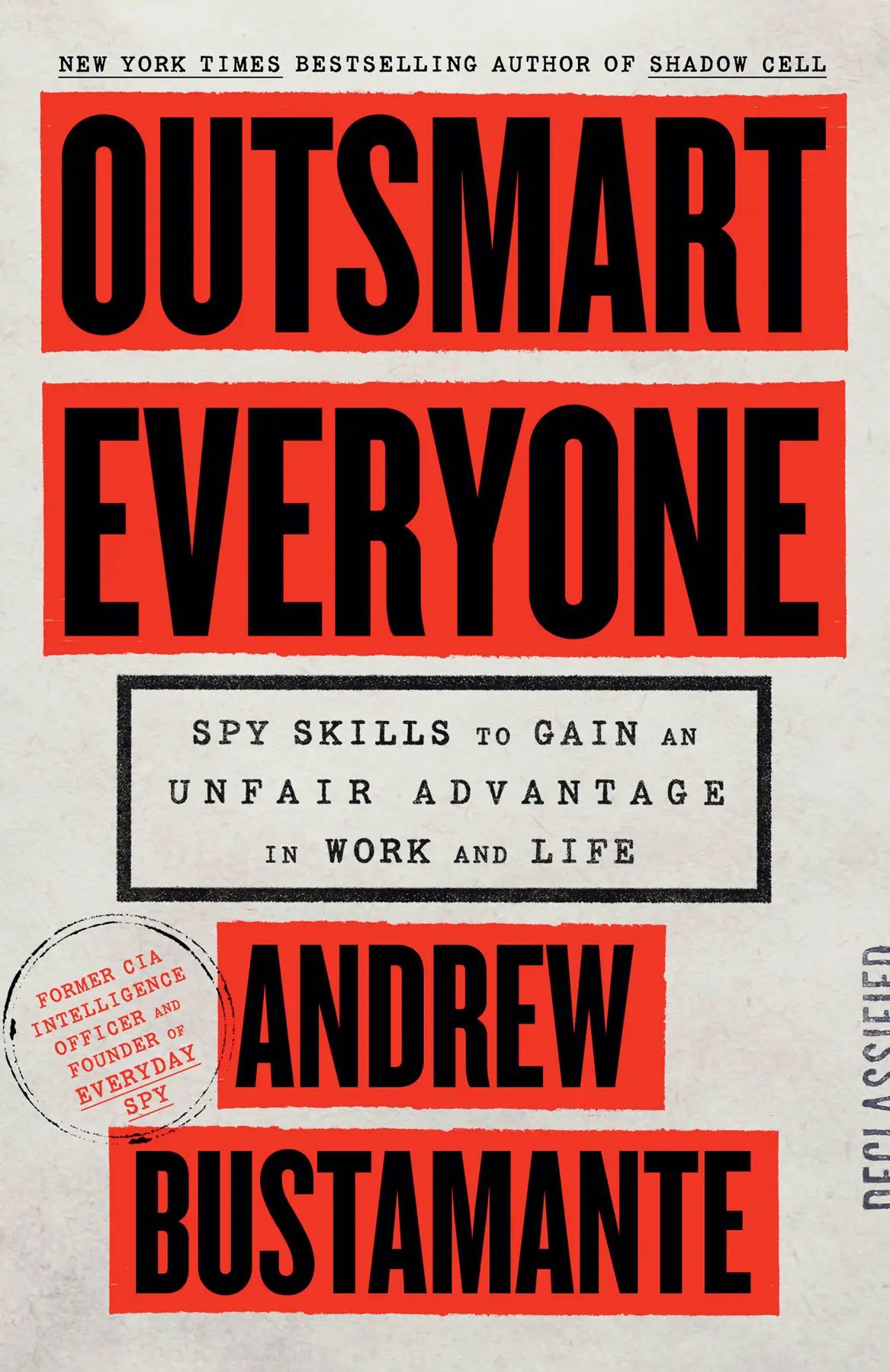
Andrew Bustamante — Outsmart Everyone: Spy Skills to Gain an Unfair Advantage in Work and Life
Little, Brown Spark, 2026 · 272 pages · ISBN 9780316572170
The book’s central idea is that better outcomes come from replacing comfortable, automatic thinking (Normthink) with deliberate, goal-directed thinking (Spythink): spend mental effort where it matters, step outside your subjective view, turn information into usable knowledge, and manage relationships and emotions strategically.
The three principles
The conclusion compresses Spythink into three rules:
-
Effort beats instinct.
Default reactions, habits, and mental shortcuts save energy, but they can also produce bad judgments. Deliberate thinking creates an advantage when the situation matters. -
Objectivity beats subjectivity.
My first-person street view is inevitably shaped by emotion, bias, assumptions, and limited information. I should deliberately seek a broader satellite view. -
Goals beat processes.
Activity is not the same as progress. Judge actions, information, and relationships by whether they move me toward the outcome I actually want.
Working formula
Notice the autopilot → create distance → clarify the outcome → gather better information → act deliberately.
Core concepts
Normthink vs. Spythink
Normthink = comfortable, reassuring, socially reinforced thinking that may not serve my interests.
Spythink = deliberate thinking that challenges automatic reactions and asks what the situation actually requires.
A useful mental contrast:
| Normthink | Spythink |
|---|---|
| Accept the first plausible answer | Ask what else could explain it |
| Follow intuition automatically | Apply attention deliberately |
| Stay in street view | Move to satellite view |
| Seek confirming evidence | Look for disconfirming evidence |
| Collect more information | Convert relevant information into knowledge |
| Stay busy | Optimize for the desired outcome |
| React emotionally | Treat emotion as information, then choose a response |
Trigger question
Whenever something feels obvious, effortless, emotionally charged, or unusually certain, ask:
Am I seeing reality clearly, or am I accepting the easiest story my brain has produced?
1. Attention beats intuition
The brain tends to conserve effort by using shortcuts. Those shortcuts are useful, but the book argues that they become dangerous when we treat them as conclusions rather than starting points.
Key idea: ATTENTION > INTUITION
Intuition can generate a fast answer. Attention interrogates it.
Example from the annotations: if asked for the “best” car, an intuitive answer may immediately surface a brand. Attention asks what best means: safety, comfort, reliability, fuel economy, status, price, or something else.
Practice
Before accepting a fast judgment:
- Define the criterion.
- Ask what evidence produced the first answer.
- Ask what information would change the answer.
- Separate familiarity from quality.
- Trust, but verify.
Decision prompt
What does “best” mean for this specific outcome?
2. Street view vs. satellite view
Street view is the immediate, first-person interpretation of events.
Satellite view is a more detached perspective that includes context, alternative explanations, other people’s viewpoints, and my own possible distortions.
A useful example from the annotations is criticism at work:
- Street view: “My boss hates me” / “I’m being singled out.”
- Satellite view: What was actually said? Which parts are valid? Is criticism normal in this environment? What other explanations fit?
Satellite view does not mean suppressing emotion. Emotion is part of the data. The goal is to stop one feeling or perspective from becoming the whole map.
Satellite-view checklist
- What are the observable facts?
- What interpretation am I adding?
- What am I assuming about motive?
- What would a neutral observer notice?
- What would someone who disagrees with me say?
- What evidence would contradict my current story?
- Is this path moving me toward the outcome I want?
3. The three ways thinking gets warped
The annotations repeatedly distinguish three categories:
Cognitive dissonance
Conflict between beliefs, goals, or behaviors.
Examples:
- Wanting to save money while rationalizing an expensive purchase as an “investment.”
- Procrastinating while claiming to care about an important goal, then saying “I work better under pressure.”
Response: identify the contradiction rather than inventing a story that makes it disappear.
Cognitive bias
Systematic shortcuts that skew how information is selected or interpreted.
Highlighted examples include:
- In-group bias — trusting or supporting people because they feel like part of “our” group.
- Halo effect — one positive characteristic colors the entire judgment.
- Horns effect — one negative characteristic colors the entire judgment.
- Dunning–Kruger effect — limited knowledge can coexist with inflated confidence.
Cognitive distortion
A warped lens that affects information before deliberate analysis begins.
Highlighted examples include:
- Generalization — extrapolating from too little data.
- Black-and-white thinking — treating complex situations as binary.
- Personalization — blaming myself for outcomes with many causes or factors outside my control.
- Emotional reasoning — treating a feeling as proof that an interpretation is true.
Confidence check
High confidence is not proof of accuracy. When I feel unusually certain, use that certainty as a cue to inspect assumptions.
Anti-warping protocol
- Interrogate assumptions with Why? and Why not?
- Seek evidence that could contradict the current belief.
- Ask several people, not only the people who usually agree with me.
- When a task looks easy, ask whether confidence is outrunning competence.
- When a task feels impossible, test whether binary thinking is hiding smaller solvable steps.
- Return to the outcome: Is this thought helping me act effectively?
4. Get comfortable with cognitive discomfort
One exercise in the annotations deliberately creates cognitive dissonance: read a serious argument from a source or viewpoint I expect to disagree with, then observe my internal response.
The purpose is not to automatically change beliefs. It is to learn the feeling of cognitive resistance.
Notice:
- the urge to dismiss the source without examining the claim;
- the desire to escape to familiar material;
- anger or frustration;
- black-and-white labeling;
- whether the source’s identity is coloring judgment of individual facts.
5. Emotions are signals, not commands
The book treats emotions as fast information. The useful move is neither obey emotion automatically nor suppress it completely.
Name it to tame it
When an emotion appears:
- Name it precisely.
- Separate the emotion from its trigger.
- Separate both from the physical response.
- Observe what interpretation the emotion is pushing me toward.
- Choose a response deliberately.
Example:
Trigger → emotion → body response → interpretation → action
This makes the chain visible before it becomes an automatic reaction.
Emotional hijacking
The annotations describe an emotional hijacking as a chain reaction in which strong emotion can take over perception and behavior.
Useful responses highlighted in the book:
- slow the physiological response;
- use box breathing (4 in / 4 hold / 4 out / 4 hold);
- identify recurring triggers;
- monitor the emotional state with as much distance as possible;
- either communicate what needs to change or remove/reframe myself from the situation.
Reframing
If a colleague interrupts repeatedly, one interpretation is “they don’t respect me.” Another is “they are enthusiastic or unaware of the effect.”
Reframing does not mean pretending the behavior is acceptable; it creates enough distance to choose the response.
6. Stress: challenge without overload
The annotations distinguish:
- Eustress — stress experienced as a manageable challenge that can support growth.
- Distress — stress that overwhelms coping capacity.
A practical framing from the highlights:
| Beginning | Ending |
|---|---|
| Distress: “I’m unprepared / overwhelmed.” | Relief |
| Eustress: “This is challenging.” | Accomplishment |
The book recommends gradually increasing exposure to difficult situations rather than jumping immediately into an overwhelming version.
Example: if public speaking is intimidating, start with a smaller, manageable audience rather than the highest-stakes presentation available.
Claims to verify separately
Some annotations make specific physiological claims about cortisol, glucose, calories, and willpower. Keep those as the author’s claims, not established conclusions, unless independently checked against current scientific evidence.
7. Resources, momentum, and strengths
The book repeatedly treats time, energy, and attention as scarce resources.
Build momentum
Rather than beginning every day with the hardest possible task, the annotations suggest using small completions to create momentum—“line up the dominoes.”
Idea: make natural brain chemistry and motivation work for the task instead of constantly fighting them.
Practical use
- Define the few tasks that make later tasks easier.
- Finish small enabling actions early.
- Protect energy for high-value work.
- Avoid leaving many cognitively “open” tasks competing for attention.
Improve strengths, not weaknesses
A highlighted claim is:
Improve your strengths, not your weaknesses.
The underlying idea is opportunity cost: time spent moving a deep weakness toward average performance may generate less return than improving an existing strength that creates distinctive value.
A balanced interpretation for my own use:
- Fix weaknesses that are constraints, risks, or minimum requirements.
- Invest disproportionate growth effort in strengths that can become leverage.
8. Information is not knowledge
A major theme in the second half of the annotations is that more information does not automatically create better judgment.
The problem:
We are exposed to a firehose of information, but information can be biased, misleading, irrelevant, or false.
The desired transformation is:
Data / information → evaluation → connection → meaning → action
Receiving vs. indexing
The annotations describe two mental modes:
- Receiving — taking in new information.
- Indexing — processing, connecting, organizing, and storing it.
Constant meetings, feeds, messages, and reading can trap me in receiving mode.
Indexing breaks
After a high-information interaction, create even 5–10 minutes without new inputs.
Use the break to answer:
- What mattered?
- What changed?
- What connects to something I already know?
- What needs action?
- What should be discarded?
This is especially compatible with Obsidian: turn passive highlights into linked concepts and decisions.
9. Vet → Validate → Analyze → Synthesize
This is one of the most reusable frameworks in the annotations.
1. Vet the source
Assess the credibility of the source.
Questions:
- Who is providing this?
- What is their access to the facts?
- What incentives or biases might affect them?
- What is their track record?
2. Validate the information
Assess the quality of the claim itself.
Questions:
- Is it internally consistent?
- Is it firsthand, secondhand, or inferred?
- Is there corroborating evidence?
- Is it current and relevant?
3. Analyze
Cross-reference the information with complementary knowledge.
Questions:
- What patterns or contradictions appear?
- What else would have to be true?
- How does this fit what I already know?
- What alternatives explain the same evidence?
4. Synthesize
Transform the analysis into a useful form.
Possible outputs:
- a decision;
- a prediction to test;
- a plan;
- a concise explanation;
- a new question;
- a linked permanent note.
Analysis paralysis
Analysis becomes counterproductive when it stops serving an outcome. Set a decision threshold: What would I need to know to act?
10. Observation: macro vs. micro
The annotations distinguish two observation modes.
Macro observation = pattern-level perception; enough to navigate a familiar environment efficiently.
Micro observation = deliberate attention to details that are normally filtered out.
Examples in the annotations:
- In an interview, notice posture changes, facial expressions, and note-taking patterns.
- In an office, observe how employees interact when they pass each other.
- When entering a familiar environment, deliberately switch into micro mode when there is a reason to inspect for anomalies.
Practice
Before entering an important environment, define what category of signal matters.
For example:
- interview → engagement, hesitation, note-taking;
- negotiation → changes in tone, pacing, questions;
- meeting → who speaks, who is deferred to, who is ignored;
- physical environment → what is different from baseline.
The point is not “notice everything.” It is direct attention intentionally.
11. Questions are intelligence tools
The annotations contrast closed and open questions.
Closed-ended questions produce bounded answers:
- yes/no;
- a number;
- a specific fact.
Open-ended questions can reveal context, reasoning, emotion, priorities, and unexpected information.
Examples:
- Closed: “Did you enjoy the movie?”
- Open: “How did you feel about the movie?”
Better conversation sequence
- Start open to discover the landscape.
- Listen for useful threads.
- Follow the thread with narrower questions.
- Use closed questions to confirm specifics.
- Summarize what I think I heard and let the person correct me.
High-yield prompt
“Walk me through how you arrived at that.”
12. Authenticity as an operational advantage
One early highlight says:
Know yourself and be yourself.
The surprising argument is that even when someone is operating under an alternate identity, staying close to the truth reduces cognitive load and makes behavior more natural.
Applied outside espionage:
- unnecessary persona-management consumes attention;
- fabricated impressions are harder to maintain under stress;
- authenticity makes interactions easier to remember and more consistent.
The annotations contrast this with social-media curation, where people may optimize for appearing happier, smarter, more attractive, or more successful than they feel.
Personal takeaway
Do not spend scarce cognitive resources maintaining a version of myself that is needlessly far from reality.
13. Goal orientation
The conclusion’s “goals beat processes” principle ties the rest of the book together.
Before investing time, energy, information, or social capital, ask:
What outcome am I trying to create?
Then evaluate:
- Does this task move me closer to it?
- Is this relationship strategically or personally valuable?
- Is this information relevant?
- Is this process useful, or am I following it because it is familiar?
- What is the smallest action that creates meaningful movement?
This turns “being productive” into resource allocation toward outcomes.
My operating checklist
Spythink — quick reset
- Outcome: What do I actually want?
- Autopilot: What answer/reaction appeared automatically?
- Emotion: What am I feeling, and what is it signaling?
- Assumptions: What am I treating as true without checking?
- Satellite view: What would this look like from outside me?
- Contradiction: What evidence could prove my current view incomplete?
- Information: Do I need more input, or do I need to process what I already have?
- Source quality: Have I vetted and validated the important claims?
- Action: What move best serves the outcome now?
- Review: What happened, and what should I update?
Experiments to try
- Before one important decision this week, write down the intuitive answer and then deliberately search for a credible contradiction.
- Add a 5–10 minute indexing break after a high-information meeting.
- Use the Vet → Validate → Analyze → Synthesize framework on one article or business decision.
- During one emotionally charged moment, label
trigger → emotion → body response → interpretation. - In one conversation, replace a closed question with an open “how” or “what” question and follow the unexpected thread.
- Choose one familiar environment and deliberately switch from macro to micro observation for two minutes.
- Identify one weakness that only needs to meet a minimum threshold and one strength worth turning into leverage.
- For one difficult problem, explicitly write the desired outcome before listing tasks.
Questions I want to revisit
- Where do I rely on intuition even though the decision is important enough to deserve deliberate attention?
- Which emotions most reliably distort my street view?
- What kinds of evidence do I avoid because they threaten an existing belief?
- Am I collecting information as a substitute for making a decision?
- Which recurring meetings or reading habits leave no time for indexing?
- What are my highest-leverage strengths?
- Which relationships genuinely create mutual value?
- Where am I optimizing a process that no longer serves the goal?
- What does “enough information to act” look like for the decisions I make repeatedly?
- Which of the book’s psychology/physiology claims should I independently verify before adopting them?
Selected highlights
“The antidote to Normthink is Spythink.”
“ATTENTION > INTUITION”
“Trust but verify.”
“What we really need is not information at all. It’s knowledge.”
“Vet the source. Validate the information. Analyze. Synthesize.”
“Effort beats instinct.”
“Objectivity beats subjectivity.”
“Goals beat processes.”