books booknotes learning productivity
Tldr
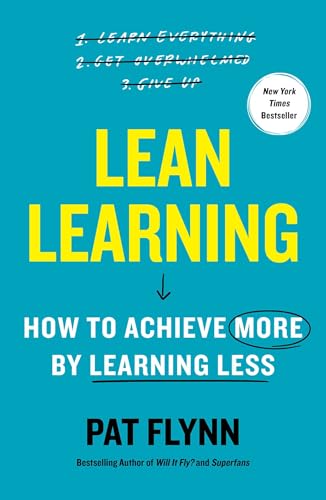
Pat Flynn — Lean Learning: How to Achieve More by Learning Less
Simon & Schuster, 2025 · 272 pages · ISBN 9781668027646
Stop consuming content in hopes of finding the answer. Decide what you want to accomplish, learn only what moves you forward, act, then review. The book’s tools are the minimum viable action and just-in-time information.
Knowing is not learning
“It ain’t what you don’t know that gets you into trouble. It’s what you know for sure that just ain’t so.”
—Mark Twain
- We find ourselves endlessly consuming more content, downloading the latest podcasts, watching the newest videos, reading the most recent articles, all in the hope that one of these will provide the elusive answer we are seeking.
- As we navigate through an era marked by swift changes and endless choices, the ability to adapt quickly has never been more crucial. The rise of artificial intelligence and the relentless expansion of digital information have transformed how we all live and work, requiring a shift in how we acquire and apply knowledge.
- Action without information is chaos, but information without action is a waste.
The learning loop
- Identify what you want to accomplish next.
- Learn only what you need to move forward.
- Implement what you’ve learned.
- Review and repeat to refine the process to deepen understanding and skill.
As Viktor Frankl once captured perfectly in Man’s Search for Meaning: “Life is never made unbearable by circumstances, but only by lack of meaning and purpose.” When we bounce back and forth from one hobby to the next, tackling yet another new idea that we never complete, our lives feel vague and meaningless. But when we dedicate ourselves to a single pursuit and can see ourselves improve, everything changes.
Filters for attention
- Inspiration overload is the default state; necessity-driven inspiration is the alternative.
- Ask: Is this truly adding value to my life, or is it merely appealing because it’s popular or visible right now?
- Ask: What am I sacrificing by indulging in this distraction?
- Ask: Does this align with my long-term goals and values, or is it just a momentary diversion?
- By applying these filters, you not only protect your time and energy but also ensure your focus remains on enriching pursuits that align with your core interests and aspirations.
Action over preparation
- The number one thing wasting your time is overthinking, overlearning, and asking too many questions before you try. The only way to truly know is to commit to taking action, and then do it.
- Discovering that a path isn’t right for you is not a setback; it’s an insight.
- Motivation alone won’t reshape your world. Only action can transform inspiration into tangible progress.
- JFGS: Just freaking get started.
- The minimum viable action, or MVA, is the shortest, simplest version of what it takes to get a result.
- For the Lean Learner, mistakes are more than missteps.
- Addressing fear head-on is part of the work, as The War of Art describes.
- “Success is not final, failure is not fatal: it is the courage to continue that counts.”
Disguised distractions
- Sometimes, the real trouble comes from things we think are helping us, but actually do the opposite.
- These can be the sneakiest distractions because they look like they’re on our side, when really they’re just slowing us down.
Just-in-Time Information
- Just-in-Time Information (JITI) is a crucial component of the Lean Learning process. It’s all about acquiring only the information necessary to accomplish your next step, which helps prevent information overload and keeps you focused on what’s most important at any given moment. Protect that next step.
- Identify the next step in your journey.
- Gather the minimum amount of information required to complete that step.
- Take action and complete the step.
- Rinse and repeat.
- When you commit to JITI and concentrate on the necessary information for your next action, you might encounter FOMO, the fear of missing out.
- Remember: if it doesn’t relate, eliminate.
- “If the road is easy, you’re likely going the wrong way.” —Terry Goodkind
Facing fear
- Most people fear public speaking, and I was definitely in that group, but I was an extreme case. Despite knowing public speaking would be hugely benefici…
Selected highlights
“Action without information is chaos, but information without action is a waste.”
“Discovering that a path isn’t right for you is not a setback; it’s an insight.”
“Remember: if it doesn’t relate, eliminate.”
“JFGS: Just freaking get started.”