Tldr
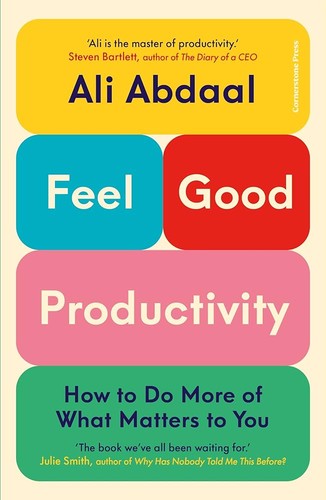
Ali Abdaal — Feel-Good Productivity: How to Do More of What Matters to You
St. Martin’s Press, 2024 · 300 pages · ISBN 9781250865045
Sunday Times and New York Times bestseller. The central claim: the secret to productivity isn’t discipline or grind — it’s feeling good. Positive emotions aren’t a reward for success; they’re the fuel for it. The book is structured in three parts: Energize, Unblock, and Sustain.
Book details: aliabdaal.com/feel-good-productivity
The core idea
Success doesn’t lead to feeling good. Feeling good leads to success.
Feeling good doesn’t just end with feeling good. It actually changes our patterns of thought and behaviour. The immediate effect of positive emotions: when we’re feeling good, our minds open up, we take in more information, and we see more possibilities around us. Consider the candle problem: in a positive mood, participants were able to see a broader range of potential solutions.
Part 1: Energize
Play
the psychological function of play is to restore the physically and mentally fatigued individual through participation in activity which is pleasurable and relaxing.
- Life is stressful. Play makes it fun.
- Play isn’t a distraction from the work — it’s an energizer for it.
Adventure
- But as we get older, this spirit of adventure gets slowly squeezed out of us.
- Harnessing your curiosity is a second method for building adventure into your life.
- Being curious about everything not only makes you more creative. It enriches your life.
- By adding a side quest to your day, you create space for curiosity, exploration and playfulness.
Flow
- In the study of rock climbers, most climbers were completely immersed in the process (climbing the wall) rather than the end result (winning the game). The pioneer of the study of ‘flow’ — that state in which we’re so immersed in a task that the rest of the world seems to melt away.
- Learn to focus on the process, rather than the outcome.
Part 2: Unblock
Confidence
- No failure is ever just a failure. It’s an invitation to try something new.
- Lower the stakes. Failures are only failures when you think they are.
- Confidence comes down to how much belief we have that we’re able to achieve our objectives. Believing you can is the first step to making sure you actually can.
- Confidence isn’t something you’re born with; it’s something you learn.
- If they can, you can too.
The confidence switch
Next time you’re feeling like a task or project is particularly difficult, ask yourself: ‘What would it look like if I were really confident at this?’ Just by asking yourself the question, you’ll visualise yourself confidently approaching the task at hand. The switch has been flipped.
Agency
- By letting go of the idea that we know everything, or somehow should, we actually feel more powerful.
- ‘He who teaches learns.’
- Sometimes, we’re right: there is nothing we can do. But often we have more agency than we realise.
- When we can’t take ownership of the situation, we can still take ownership of the process.
Viktor Frankl
Everything can be taken from a man but one thing: the last of the human freedoms — to choose one’s attitude in any given set of circumstances, to choose one’s own way.
People
- The Benjamin Franklin effect: when we ask someone for help, it’s likely to make them think better of us. It’s the flipside of the transformative effects of helping others: we can ask others to help us, which will help them feel better, too.
- The easiest way to do this is by simply adopting a maxim: people are more eager to help than you think.
- But there’s a downside. Lying — even lying with good intentions — has a physiological effect. Lying is associated with the activation of the limbic system, the same area of the brain that initiates the fight-or-flight response. When we’re honest, this area of the brain shows minimal activity; when telling a lie, it lights up like a fireworks display.
The Unblock method
The unblock method encourages us to understand why we’re feeling bad about work in the first place — and tackle the issue head on. The biggest blocker is the fog of uncertainty.
Borrowed from military strategy — Commander’s Intent:
- The purpose behind the operation
- The end state that the commander was aiming for
- The key tasks that the commander felt should be taken to accomplish the objective
Goals gone wild
‘Goals gone wild: the systematic side effects of overprescribing goal setting’ — if you don’t know when you’re doing something, chances are you won’t do it. Unclear, overprescribed goals are a documented source of stress and procrastination.
Selected highlights
“Success doesn’t lead to feeling good. Feeling good leads to success.”
“Life is stressful. Play makes it fun.”
“No failure is ever just a failure. It’s an invitation to try something new.”
“Believing you can is the first step to making sure you actually can.”
“When we can’t take ownership of the situation, we can still take ownership of the process.”
“He who teaches learns.”