A Method is a function that is associated with a specific type.
Methods are used to add behavior to types, especially custom types like Struct, making them essential for object-oriented programming in Go.
They allow you to define functions that operate on the data contained within a specific instance of a type.
Methods - Practical Go Lessons
Remember
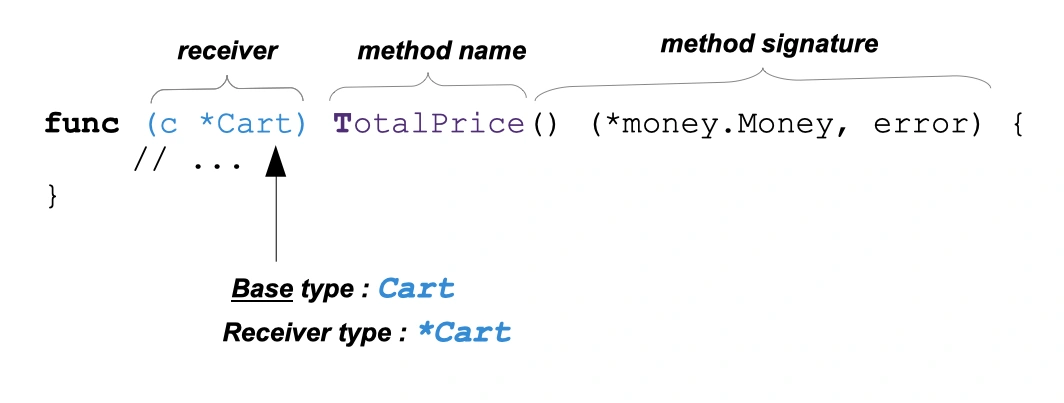
A method is just a function with a receiver argument.
Method vs Function
| Aspect | Method | Function |
|---|---|---|
| Type association | Associated with a specific type via a receiver | Not associated with any specific type |
| Receiver | Has a receiver parameter | No receiver |
| Purpose | Adds behavior to a type, supports encapsulation | General-purpose |
| Interfaces | Can be part of an interface method set | Cannot be part of an interface |
| Invocation | Called on a specific instance of the type | Called directly by function name |
// Method with a receiver of type `Person`
func (p *Person) UpdateName(newName string) {
    p.Name = newName
}

// Function without a receiver
func updateName(p *Person, newName string) {
    p.Name = newName
}
Method Receivers: Value vs. Pointer
1. Value Receiver (func (p Person) Greet() {...})
- A copy of the value is made when the method is called.
- The original value remains unchanged if modified within the method.
- Value receivers are typically used when you don’t need to modify the receiver’s data or for small types where copying is inexpensive.
2. Pointer Receiver (func (p *Person) Greet() {...})
- A pointer to the receiver value is passed to the method.
- Modifications made within the method affect the original value.
- Pointer receivers are used when you want the method to modify the receiver’s data or for large types to avoid copying overhead.