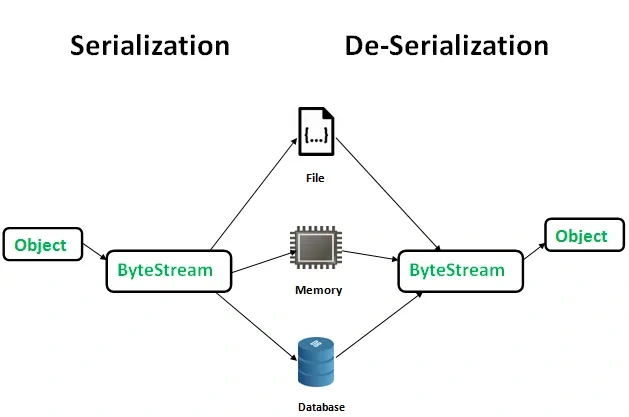
**Serialization** is the process of converting an object, data structure, or state into a format that can be easily stored or transmitted and later reconstructed (deserialized).
It is commonly used to exchange data between systems, store data in files or databases, or transmit data over networks.
Common Use Cases for Serialization:
- Data Storage:
- Save an object’s state to a file or database in a structured format like JSON, XML, or binary.
- Data Transmission:
- Send objects or data between applications over networks using formats like JSON or XML.
- Caching:
- Store serialized data in memory or a distributed cache for quick retrieval.
- Remote Procedure Calls (RPCs):
- Serialize function parameters or objects to communicate between distributed systems.
- Procedure Calls > RPC
- Logging and Debugging:
- Log structured data in human-readable formats like JSON.
package main

import (
	"encoding/json"
	"fmt"
)

type Person struct {
	Name  string `json:"name"`
	Age   int    `json:"age"`
	Email string `json:"email"`
}

func main() {
	// Create an instance of the struct
	person := Person{Name: "Alice", Age: 30, Email: "alice@example.com"}

	// Serialize the struct to JSON
	data, err := json.Marshal(person)
	if err != nil {
		fmt.Println("Error serializing:", err)
		return
	}

	fmt.Println("Serialized JSON:", string(data))
}
See