“Dependency Injection” is a 25-dollar term for a 5-cent concept.Dependency injection means giving an object its instance variables.” - James Shore: Dependency Injection Demystified
Inversion of Control Containers and the Dependency Injection pattern
Fundamentals
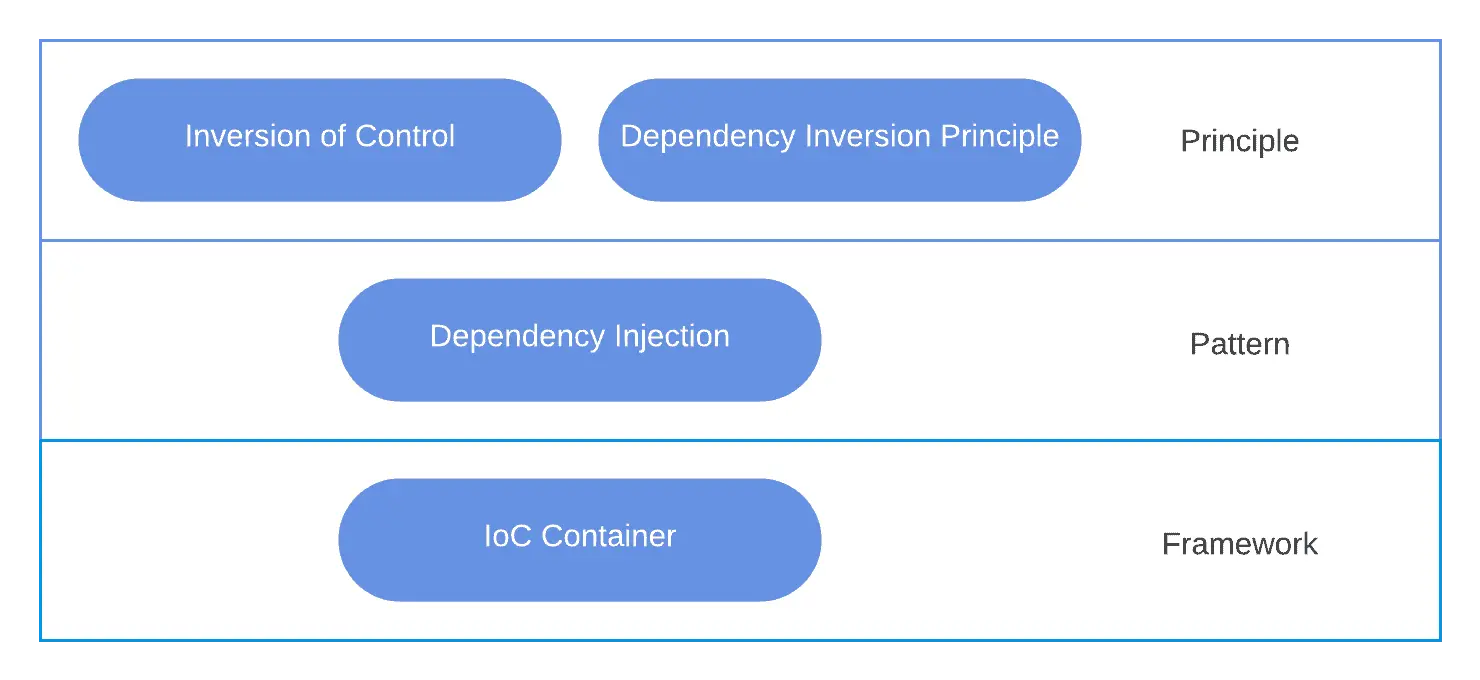
Inversion of Control (IoC)
Inversion of Control (IoC) is a design principle where the control of object creation and dependency management is transferred from the class itself to an external entity (e.g., a framework or container).
- Without IoC: A class creates its own dependencies (Tightly Coupled).
- With IoC: Dependencies are provided externally, making the class loosely coupled and more flexible.
IoC is a broader concept, where the framework controls object creation and flow.
Dependency Injection (DI) is a way to achieve IoC, where dependencies are injected rather than created inside the class.
DIP
Transclude of af01.6---dependency-inversion-principle-(dip)
DI
Dependency injection (DI) is a design pattern that decouples classes from their dependencies by externalizing their creation and management. Instead of a class constructing its dependencies directly.
Core Concepts:
- Decoupling
- Testability
- Reusability
classDiagram
    class Engine {
        <<interface>>
        +start() void
    }

    class PetrolEngine {
        +start() void
    }

    class DieselEngine {
        +start() void
    }

    class Car {
        -Engine engine
        +Car(Engine engine)
        +drive() void
    }

    Engine <|-- PetrolEngine
    Engine <|-- DieselEngine
    Car --> Engine : "Dependency Injection"
Types of DI
- Constructor Injection
- Setter Injection
- Interface Injection
In Dependency Injection (DI):
- Use setter injection when the dependency is optional.
- When the dependency is required, there is no point in using setter injection.
Example
Without DI(Tightly Coupled):
Class Car {
	private Engine engine = new PetrolEngine();

	// Rest of the code..
}
With DI:
Class Car {
	// Inject an Instance of Engine (dependency of car) at runtime
	private Engine engine;
	// Construter Injection
	Car(Engine engine) {
		this.engine = engine;
	}

	// OR we can use Setter Injection
	void setEngine(Engine engine) {
		this.engine = engine
	}
}
YouTube