Core Idea
Distributed systems split into a control plane that decides where data and resources go, and a data plane that moves the actual traffic; the same split appears in Kubernetes, Istio, and S3.
- Definitions and a comparison of control plane versus data plane (forwarding plane).
- Real-world examples: Kubernetes, a service mesh like Istio, and cloud storage like Amazon S3.
- A closing section on network planes.
In distributed systems, the architecture is often split into two distinct layers: Control 1Plane and Data Plane.
Control Plane
It’s a management layer; responsible for the making decisions about where data should go, how resources should be allocated and ensuing the system’s desired state is maintained.
Data Plane aka Forwarding Plane
It’s an execution layer; responsible for the actual processing of user requests and the movement of data across the system based on the instructions it receives from the control plane.
Comparison
| Feature | Control Plane | Data Plane |
|---|---|---|
| Primary Goal | Decision making & Management | Execution & Data movement |
| Performance | High complexity, low frequency | Low complexity, high frequency |
| Latency Sensitivity | Lower (can tolerate small delays) | Extremely high (must be near-instant) |
| Scale | Scales with system complexity | Scales with traffic volume |
| Failure Impact | System becomes “frozen” (no changes) | System stops working (no data moves) |
Real World Examples
1. Kubernetes
- Control Plane: The
kube-apiserver,scheduler, andetcd. It decides which “Node” a “Pod” should run on. - Data Plane: The
kubeletand the actual containers running on worker nodes. They do the actual work of running your application.
2. Service Mesh (E.g., Istio)
- Control Plane: The management component (
istiod) that distributes security certificates and routing rules. - Data Plane: The Envoy sidecar proxies that sit next to every service, intercepting, and routing the actual network traffic.
3. Cloud Storage (E.g., Amazon S3)
- Control Plane: Handles the APIs for creating a bucket, setting permissions, or listing files.
- Data Plane: Handles the actual
PUTandGETrequests to upload or download your multi-gigabyte files.
Tip
The term Control Plane has it’s roots in physical network routing and switching, but around a decade ago the term was hijacked by developers creating the first wave of cloud-native systems. These days, in cloud systems, a Control Plane has come to mean a piece of software, usually some kind of platform exposed via an API, that controls and manages other platform systems on the back end.
Network Planes
Differences Between Control, Data, and Management Planes | Baeldung on Computer Science
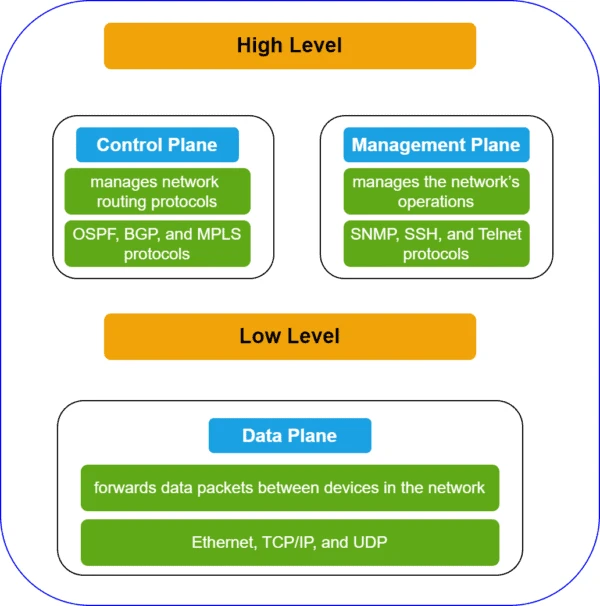
In networking, the concept of planes is used to separate decision-making, execution, and management:
- Control Plane: Responsible for managing network routing protocols and making routing decisions that enable communication between devices. It determines the best paths for traffic but does not forward packets itself.
- Data Plane (Forwarding Plane): Responsible for forwarding data packets between devices based on the rules and routing information provided by the control plane. It handles the actual movement of traffic through the network.
- Management Plane: Responsible for configuring, monitoring, and managing the network. This includes tasks such as setting up devices, collecting statistics, and enforcing policies.
For more details, see Computer Networks: A Top-Down Approach, Chapters 4 and 5.
Footnotes
-
noun. a flat or level surface. Geometry. ↩