wso2 fhir mcp ai-based-research
Core Idea
A FHIR server is a standards-aware interoperability layer for healthcare data. It combines FHIR resource storage with validation, search, versioning, references, profiles and standardized API behavior, rather than acting as a simple CRUD database.
WSO2 FHIR Server takes a focused approach: a lightweight FHIR R4 server built with Go and PostgreSQL, using typed search indexes generated when resources are written. It provides the core persistence and search layer while expecting capabilities such as authentication, authorization, TLS, terminology services and some advanced FHIR features to be handled by surrounding platform components.
Standards-Aware Interoperability Layer —> “A layer that understands FHIR rules and uses them to let different healthcare systems exchange data consistently.”
Research boundary and evidence quality
This note reflects the documentation and repositories available on 2026-09-16. FHIR servers change quickly. Capability statements, release notes, edition restrictions and deployment configuration are more authoritative than marketing pages.
Evidence labels used below:
- Documented: stated in official documentation or a source repository.
- Vendor claim: a product claim that still needs workload-specific validation.
- Verify: depends on release, edition, plugin, configuration or an external service.
The original announcement is a LinkedIn post by Nirmal Fernando published on 2026-09-16:
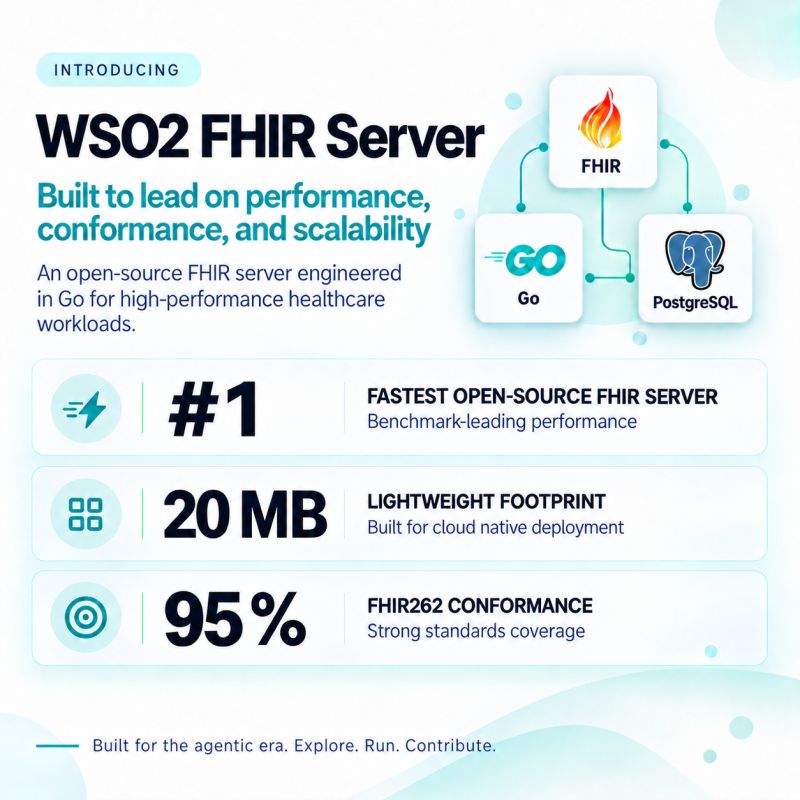
FHIR Servers
1. What problem does a FHIR server solve?
Healthcare data is distributed across EHRs, laboratory systems, pharmacies, claims platforms, imaging systems, registries, patient apps and research systems. These systems often use different schemas, identifiers, vocabularies, transport protocols and access-control models. This is the same integration and governance problem explored in REST API design and identity and OAuth security.
Without a common interoperability layer, every application needs a separate integration for every source:
flowchart TD
    A[Patient app] --> I[Custom integrations]
    C[Lab system] --> I
    D[Claims system] --> I
    I --> E[Many mappings and APIs]
    E --> F[Fragile data exchange]
FHIR, or Fast Healthcare Interoperability Resources, addresses this by defining:1
- Resources: standard information models such as
Patient,Observation,MedicationRequest,EncounterandDiagnosticReport. - Representations: commonly JSON, XML and sometimes RDF.
- Relationships: references between resources.
- Profiles and Implementation Guides: constraints for a country, payer, programme or clinical use case.
- REST interactions: create, read, update, patch, delete, search, history, transactions and operations.
- Conformance metadata: a
CapabilityStatementat/metadata. - Terminology hooks: CodeSystem, ValueSet, ConceptMap and terminology operations.
- Security integration points: commonly OAuth 2.0 and SMART-on-FHIR, although security implementation is not identical across servers.
HL7 describes FHIR as a standard for exchanging healthcare information. Its design uses resources and well-defined APIs to make information easier to exchange while retaining extensibility and clinical meaning.
The important distinction
FHIR is an interoperability specification, not a complete hospital information system. A FHIR server usually does not provide all of these things by itself:
- Clinical workflows and user interfaces.
- Identity proofing and enterprise IAM.
- Consent policy for every local legal context.
- A complete terminology business and licensing model.
- Analytics, data warehouse and AI governance.
- HL7 v2 and CDA transformation for every source.
- Backup, disaster recovery and operational support.
A production architecture normally combines a FHIR server with gateways, identity, terminology, eventing, audit, analytics and integration services.
2. Problem statement
A production healthcare platform needs a reliable, searchable and governed canonical data layer that can:
- Ingest data from different sources without losing provenance.
- Preserve the original clinical meaning and resource history.
- Validate structure, cardinality, references, profiles and terminology.
- Support predictable searches across nested and referenced data.
- Expose standard APIs to mobile, web, payer, provider and research applications.
- Enforce patient, organisation, tenant and user-level access controls.
- Handle transactions and asynchronous bulk movement of data.
- Emit audit, metrics, logs and change events.
- Operate at the required volume, latency and availability.
- Support the FHIR versions and Implementation Guides used by partners.
- Permit safe AI access without exposing uncontrolled PHI or write operations.
The engineering challenge is not just storing JSON. It is maintaining the relationship between resource bodies, versions, search indexes, references, profiles, terminology and authorization while the data is updated concurrently.
A useful target architecture is:
flowchart TD
    S[Source systems] --> X[Integration and mapping]
    X --> G[API gateway / IAM]
    G --> F[FHIR server]
    F --> P[FHIR persistence]
    F --> T[Terminology Srv.]
    F --> E[Subscriptions]
    F --> A[observability]
Why use FHIR instead of a normal REST API?
A normal REST API can expose healthcare data, but it does not provide a shared healthcare contract. Each team would need to define its own resource names, fields, identifiers, terminology, versioning, search semantics, error format and authorization model.
FHIR adds a domain standard above HTTP. It gives different organizations a common vocabulary and a predictable interaction model while still allowing extensions through profiles and Implementation Guides.1
| Concern | Normal REST API | FHIR API |
|---|---|---|
| Data model | Defined by one application or organization | Shared resource model such as Patient, Observation and MedicationRequest |
| Meaning | Hidden in custom documentation and code | Defined by HL7 resources, datatypes, profiles and terminology |
| Search | Custom query parameters and response shapes | Standard search parameters, modifiers, chaining and Bundle results |
| Version history | Must be designed by each team | meta.versionId, vread and _history are standardized interactions |
| Validation | Custom JSON Schema or application logic | Base FHIR validation plus profiles, invariants and terminology bindings |
| Interoperability | Every consumer learns a different API | Clients can reuse FHIR SDKs, validators, test suites and Implementation Guides |
| References | Often informal IDs or nested objects | Typed FHIR references such as Patient/123 with defined search behavior |
| Transactions | Custom bulk endpoints or database semantics | Standard batch and transaction Bundles |
| Capability discovery | OpenAPI or custom documentation | /metadata CapabilityStatement describes supported FHIR behavior |
| Ecosystem | General web tooling | Healthcare-specific tooling, registries, terminology services and compliance profiles |
FHIR is not automatically better for every API
Use a normal REST API for a private internal service with a narrow domain, no external interoperability requirement and a simple data lifecycle. FHIR adds modeling, validation, terminology and operational complexity.
Use FHIR when data must cross organizational boundaries, when clients need a standard clinical model, when an Implementation Guide is mandatory, or when the platform must support patient, provider, payer, research or public-health interoperability.
The practical pattern is often both:
flowchart LR
    A[External healthcare systems] --> B[FHIR API]
    B --> C[Canonical clinical model]
    C --> D[Internal REST or domain APIs]
    D --> E[Product workflows]
FHIR should be the interoperability boundary. Internal services can still use simpler domain-specific APIs behind that boundary. This connects to REST API design and identity and OAuth security.
3. What a FHIR server actually does
Core request path
sequenceDiagram
    participant C as FHIR client
    participant G as Gateway/IAM
    participant F as FHIR server
    participant V as Validator
    participant D as Database
    participant T as Terminology

    C->>G: HTTPS request with token
    G->>G: Authenticate and bind tenant
    G->>F: Authorized FHIR request
    F->>V: Parse and validate
    V->>T: Optional terminology check
    T-->>V: Code result
    V-->>F: Valid or OperationOutcome
    F->>D: Store resource and indexes
    D-->>F: Version and search state
    F-->>C: FHIR response
Main internal responsibilities
| Responsibility | Why it matters |
|---|---|
| Resource parsing | Reject malformed JSON/XML and preserve FHIR semantics. |
| Base validation | Enforce the base FHIR StructureDefinitions. |
| Profile validation | Enforce an Implementation Guide such as US Core. |
| Search indexing | Make searches predictable without scanning every resource document. |
| Versioning | Preserve current and historical resource states. |
| Referential integrity | Detect missing or unsafe local references. |
| Transactions | Apply related writes atomically when the server supports them. |
| CapabilityStatement | Tell clients what this deployment really supports. |
| Terminology | Validate codes and expand or query value sets. |
| Authorization boundary | Ensure a caller sees only permitted resources. |
| Observability | Provide evidence for availability, latency and audit. |
A FHIR server should be evaluated by its actual CapabilityStatement and tested behavior, not by the number of resource types it accepts.
4. Existing solution families
4.1 Open-source embeddable or self-hosted servers
Examples include:
- HAPI FHIR: mature Java library and JPA server, Apache 2.0.
- WSO2 FHIR Server: new Go and PostgreSQL server, Apache 2.0, currently R4-focused.
- Medplum: Apache 2.0 FHIR-native developer platform with hosted and self-hosted options, currently R4-centered.
- Microsoft FHIR Server for Azure: open-source .NET server that underpins or relates to Microsoft offerings, but the managed product lifecycle must be checked separately.
- Blaze and other focused servers: useful for particular R4 data and API use cases, but feature coverage and operational maturity vary.
These options provide control over deployment, data locality and extension. They also transfer more responsibility to the engineering team for upgrades, security, database operations, backups and support.
4.2 Commercial self-hosted platforms
Examples include:
- Firely Server: .NET-based, standards-focused, plugin-oriented and commercial.
- Aidbox: commercial PostgreSQL-based healthcare platform with a free developer tier and paid production licensing.
- Smile CDR: commercial enterprise distribution and platform built around HAPI FHIR and additional interoperability modules.
These products usually add support, certifications, administration, security integration, higher-level workflows and enterprise modules. The trade-off is licensing cost and dependency on a vendor roadmap.
4.3 Managed cloud FHIR services
Examples include:
- Azure Health Data Services FHIR service.
- Google Cloud Healthcare API FHIR stores.
- AWS HealthLake.
Managed services reduce infrastructure work and integrate with the provider’s IAM, storage, logging, analytics and AI services. The trade-offs are cloud coupling, region and data-residency constraints, service-specific behavior, quota models and less access to the underlying database.
4.4 FHIR facade and gateway solutions
A facade exposes FHIR over a non-FHIR source without necessarily becoming the system of record. It is useful when data must remain in an EHR or legacy system.
A gateway can unify several FHIR endpoints, translate versions, enforce authorization and provide a single entry point. It does not automatically fix inconsistent source semantics, missing terminology or poor upstream data quality.
4.5 Application platforms built around FHIR
Aidbox, Medplum and Smile CDR are broader than a storage server. They may include identity, UI, SDKs, bots, workflows, eventing, analytics, custom operations or integration modules.
This is useful when the team wants to build a healthcare product quickly. It is less useful when the requirement is only a small standards-compliant persistence layer.
5. Main FHIR server options
The matrix below is a first screening tool. It is not a certification matrix. A check mark means that the capability is documented somewhere in the product ecosystem. It does not mean that the capability is included in every edition or enabled by default.2
| Option | Type and architecture | FHIR coverage | Security position | Bulk/events | Main advantage | Main risk |
|---|---|---|---|---|---|---|
| WSO2 FHIR Server | Open-source Go binary with PostgreSQL | Current docs focus on R4 | Gateway or ingress expected for auth, authorization and TLS | Bulk Data and subscriptions are not in the current eight-operation list; verify releases | Small, stateless, PostgreSQL-native, typed write-time indexes | New project, R4 only, external security boundary |
| HAPI FHIR JPA | Open-source Java library and JPA server | Mature multi-version modules including R4/R4B/R5, version dependent | Extensible interceptors and external IAM; deployment team owns security | Bulk export/import, subscriptions and partitioning available with configuration/modules | Mature ecosystem, extensibility and deep FHIR feature coverage | Java/JPA operational complexity, database indexing and tuning burden |
| Firely Server | Commercial .NET pipeline with plugins | STU3/R4 and newer-version support depends on release/edition | SMART v1/v2, RBAC/ABAC and plugins documented | Bulk Data, subscriptions and terminology modules; some features separately licensed | Strong FHIR expertise, validation and plugin model | Commercial licensing, version and edition constraints |
| Aidbox | Commercial PostgreSQL platform with JSONB and app layer | Vendor docs advertise R3 through R5 and R6 ballot support | OAuth/OIDC, SMART, RBAC/ABAC and physical or logical multi-tenancy | Bulk import/export and topic-based subscriptions | Broad platform, developer tools, SQL-on-FHIR, GraphQL and AI/MCP | Proprietary production licensing and configuration complexity |
| Medplum | Apache 2.0 TypeScript platform, hosted or self-hosted | R4 is the main documented production surface | OAuth2, SMART, access policies and MFA options | Bulk Data, FHIR subscriptions, WebSockets and bots | Fast product development and strong TypeScript experience | R5 support and very large-scale behavior need current verification |
| Smile CDR | Commercial enterprise HAPI-based platform | Multi-version support depends on modules and release | Full SMART, gateway and partition security features | Bulk, subscriptions, MDM, gateway and integration modules | Enterprise support, MegaScale, interoperability modules | Commercial cost and platform complexity |
| Azure Health Data Services | Managed PaaS, SQL-backed FHIR service | Current managed service documentation lists R4 | Entra ID, SMART integration, RBAC, audit | System/group/patient $export, ADLS Gen2 and integrations | Managed operations and Azure ecosystem | Azure lock-in, managed API limits and retirement/migration boundaries |
| Google Cloud Healthcare API | Managed FHIR stores | DSTU2/STU3/R4/R5 store versions, version-specific | Google Cloud IAM and service accounts | GCS/BigQuery export and Pub/Sub/streaming integrations | Strong analytics integration and managed operations | Cloud-specific APIs and FHIR Bulk Data distinction must be checked |
| AWS HealthLake | Managed R4 data store plus analytics and NLP | FHIR R4 is the main documented surface | IAM, SigV4 and SMART options, depending on tier/configuration | Bulk export and AWS analytics; medical NLP and transformation features | AI/analytics integration and managed scale | AWS coupling, tier restrictions and product-specific behavior |
- Choose WSO2 when the core requirement is a lightweight, self-hosted R4 API and the organization already operates IAM, gateways, PostgreSQL and external terminology.
- Choose HAPI when implementation depth, community adoption, Java extensibility and broad FHIR features matter more than a small binary.
- Choose Firely when standards expertise, .NET integration, validation and vendor support are high priorities.
- Choose Aidbox or Medplum when the FHIR server is also the application platform.
- Choose Smile CDR when a supported enterprise interoperability suite is required.
- Choose Azure, Google or AWS when managed operations and deep cloud analytics are more valuable than portability.
WSO2 FHIR Server in depth
Current architecture
The current WSO2 repository describes a FHIR R4 REST server written in Go and backed by PostgreSQL. It presents a single binary plus database deployment model.3
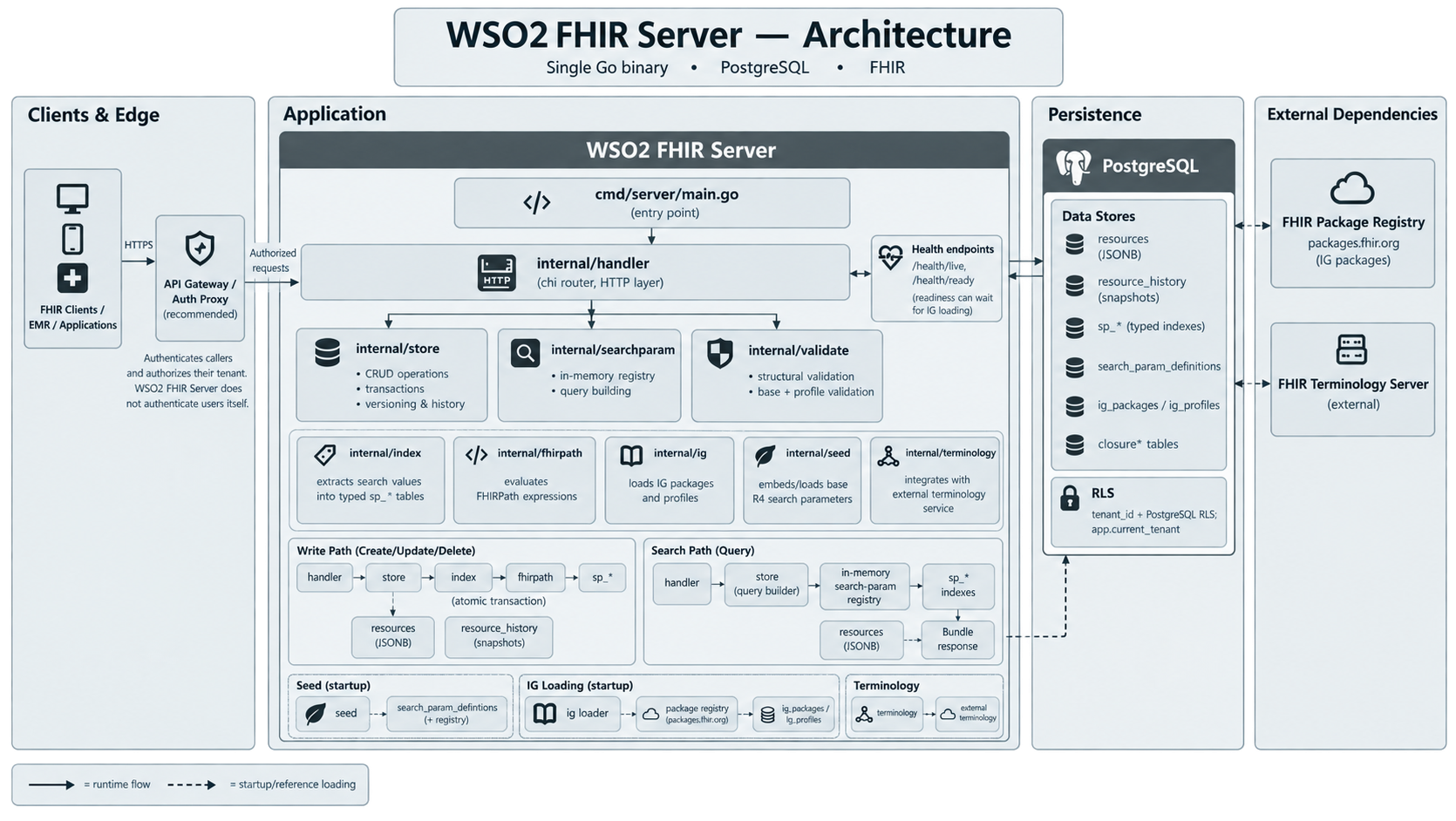
The central storage idea is:4
flowchart TD
    A[FHIR request] --> B[Parse and validate]
    B --> C[Resource JSON]
    B --> D[Extract searchable values]
    C --> E[(Resource and history tables)]
    D --> F[(Typed search tables)]
    E --> G[Search result resources]
    F --> G
The resource body remains JSON. Searchable values are extracted into typed index tables such as string, token, date, number, quantity, URI and reference indexes. A write, history snapshot and index update commit together.
This is similar in broad shape to HAPI’s resource-plus-search-index approach, but the implementation, schema and query planner are different. It is not accurate to assume that two systems will have the same performance just because both use typed indexes.
Documented capabilities
The current documentation lists:5
- CRUD, patch, versioned reads and history.
- Conditional interactions.
- Batch and atomic transaction Bundles.
- Rich R4 search, including chaining, reverse chaining,
_includeand_revinclude. - Base validation and optional profile validation.
- Implementation Guide packages loaded at startup.
- Referential integrity checks on writes and deletes.
- JSON, XML and RDF Turtle representations.
- Patient, Encounter and Practitioner compartment search.
$validate,$everything,$lastn,$document,$convert,$meta,$meta-addand$meta-delete.- Physical or shared multi-tenancy.
- Prometheus metrics, structured logs and health endpoints.
- Helm deployment and PostgreSQL Row-Level Security in shared tenancy designs.
Important boundaries
The architecture documentation explicitly places these concerns outside the server:6
- TLS termination.
- Authentication and token validation.
- Authorization and tenant binding.
- Rate limiting and network policy.
- Security audit integration.
- Terminology reasoning and ValueSet expansion.
The server documentation also warns that system-level and type-level $meta currently aggregate across the whole database in a multi-tenant deployment. Those scopes should be blocked for tenants at the gateway until their tenant behavior is safe.
The deployment documentation describes an important timeout behavior. A long transaction Bundle can continue after the HTTP write timeout closes the connection. The database transaction may commit even when the client receives EOF. A client must reconcile state before retrying.7
Performance claims
The announcement and README claim:
- Around a 20 MB binary.
- A container image under 25 MB.
- Cold start in under one second.
- A stateless and Helm-deployable service.
The current README also links to a third-party performance benchmark. That benchmark is not a neutral benchmark of WSO2: the public Health Samurai benchmark currently compares Aidbox, HAPI, Medplum and Microsoft FHIR Server, not WSO2. It is useful evidence about benchmark methodology, but it does not validate the WSO2 headline numbers.
The correct production approach is to benchmark WSO2 using:
- The same Synthea or real-shaped dataset used by the target workload.
- The required FHIR profiles and terminology configuration.
- Cold start and warm start measurements.
- CRUD, transaction Bundle, search, history and validation workloads.
- Tenant isolation tests under concurrency.
- PostgreSQL storage growth and index maintenance.
- p95 and p99 latency, not only average requests per second.
WSO2 versus HAPI FHIR
Architectural comparison
| Dimension | WSO2 FHIR Server | HAPI FHIR JPA Server |
|---|---|---|
| Runtime | Go, single binary | Java, Spring/Hibernate/JPA ecosystem |
| License | Apache 2.0 | Apache 2.0 |
| Primary storage | PostgreSQL | Relational databases through JPA, especially PostgreSQL |
| Resource body | JSON document model | Resource master/version tables with stored content |
| Search model | Typed index tables and query-plan selection | Typed HFJ search-index tables and DAO query planning |
| FHIR focus | R4 | Multiple FHIR versions through modules, version dependent |
| IG/profile model | Packages loaded at startup | Package, validation and runtime configuration options |
| Transactions | Documented atomic transactions | Mature transaction and batch support, with many configuration options |
| Bulk Data | Not in current documented operation list | Available in JPA server modules/configuration |
| Subscriptions | Not in current documented operation list | JPA subscription module supports several delivery modes |
| SMART | Expected outside the server | Usually supplied through interceptors, deployment components or commercial distributions |
| Multi-tenancy | Shared PostgreSQL RLS or dedicated deployment models | Partitioning and interceptors, with known configuration limitations |
| Extensibility | Go codebase and external gateway/services | Java providers, interceptors, modules and custom storage extensions |
| Operational footprint | Smaller by design | Heavier but feature-rich and mature |
| Project maturity | New and changing | Long-running ecosystem with broad adoption |
Decision summary
Choose WSO2 over HAPI when:
- R4 is sufficient for the whole integration boundary.
- A small Go binary and simple deployment are strategic requirements.
- PostgreSQL is the standard database platform.
- The team prefers a focused server over a broad Java framework.
- IAM, gateway, terminology and eventing are already separate platform capabilities.
- The team can accept a newer project and perform deeper conformance testing.
Choose HAPI over WSO2 when:
- Multiple FHIR versions or older integrations are needed.
- You need mature subscriptions, Bulk Data, MDM, CQL, CDS Hooks or broad modules.
- The organization already operates Java and Spring platforms.
- You need deep custom server behavior through providers and interceptors.
- The project has a long-lived HAPI community and commercial support path.
Neither choice removes the need for an enterprise security model, data governance, terminology operations, backup and disaster recovery.
AI integration and MCP servers
What MCP adds
The Model Context Protocol is a JSON-RPC-based protocol for connecting an AI host to external tools, resources and prompts. It does not make an LLM clinically safe and it does not replace OAuth, SMART-on-FHIR, audit or consent.8 This follows the vault’s three-tier MCP architecture and AI-native platform governance patterns.
For FHIR, MCP is an adapter layer:
flowchart LR
    U[User] --> H[AI host]
    H --> M[MCP server]
    M --> I[IAM and policy]
    I --> F[FHIR server]
    F --> D[(Clinical data)]
    M --> R[Redaction and FHIRPath filtering]
    R --> H
The FHIR server remains the system that understands resource validation, search semantics, history and authorization. The MCP server should translate carefully bounded tool calls into FHIR requests.8
WSO2 FHIR MCP Server
WSO2 publishes a separate wso2/fhir-mcp-server project. It is a general MCP bridge that can expose any compatible FHIR server, not only the WSO2 Go server. The repository includes examples using HAPI FHIR.
Documented capabilities include:9
- MCP transports: stdio, SSE and Streamable HTTP.
- SMART-on-FHIR or OAuth 2.0 authorization support.
- FHIR
CapabilityStatementdiscovery through aget_capabilitiestool. search,read,create,updateanddeletetools.- Custom FHIR operations such as
$everything,$lastnand$expandwhere the upstream server supports them. get_usersupport when the token includes suitablefhirUserand OpenID scopes.- Optional FHIRPath filtering on
readandsearchresponses to reduce payload size and LLM context use. - Docker and Python package deployment options.
- Compatibility with MCP clients such as VS Code, Claude Desktop and MCP Inspector.
The conceptual flow is:
sequenceDiagram
    participant L as LLM host
    participant M as WSO2 FHIR MCP
    participant O as OAuth or SMART
    participant F as Any FHIR server

    L->>M: tools/list
    M-->>L: capabilities and bounded tools
    L->>M: search Patient or Observation
    M->>O: obtain or use scoped token
    O-->>M: access token
    M->>F: FHIR search with scope
    F-->>M: Bundle
    M->>M: Apply FHIRPath field filter
    M-->>L: Reduced FHIR result
MCP capability comparison
| Platform | Native or companion AI/MCP path | What it is good for | Important boundary |
|---|---|---|---|
| WSO2 FHIR Server | Separate WSO2 FHIR MCP Server adapter | Expose WSO2 or another FHIR API to MCP clients; discovery, search, read, bounded CRUD and operations | The adapter is not a clinical reasoning engine. Secure the upstream FHIR server and default to read-only. |
| HAPI FHIR | JPA server starter has an MCP configuration path; external adapters also work | MCP tools over HAPI operations and, in emerging work, CDS Hooks | Check the exact starter release. An MCP bridge must preserve search parameters and patient scopes. A reported starter issue shows why this must be tested for PHI isolation. |
| Aidbox | Native Aidbox MCP module and AI documentation | CRUD, search, conditional operations, validation and direct connections from MCP clients | Production endpoints require strict AccessPolicy and token controls. Native MCP exposes write capabilities, so approval gates are essential. |
| Firely Server | Plugin and API ecosystem, SMART and custom integrations | Standards-heavy applications and controlled .NET extensions | No equivalent native MCP capability was confirmed in the reviewed official sources. Use a separate adapter and verify licenses. |
| Medplum | Bots, TypeScript SDK, GraphQL and external MCP adapters | Build application-specific agents and workflows around FHIR data | Agent behavior is application code. Enforce AccessPolicy, audit and least privilege. |
| AWS HealthLake | AWS AI/NLP, Data Transformation Agent and AWS agent tooling | Convert unstructured data, analytics and model workflows around managed FHIR R4 | AI services do not automatically give an LLM safe FHIR access. Use IAM, SMART and a controlled tool layer. |
| Azure / Google | Azure AI or Vertex AI integrations and cloud APIs | Managed data, analytics and AI pipelines | Cloud AI integration is broader than a native FHIR MCP surface. Build and govern the adapter. |
Safe MCP reference design
For clinical or PHI-bearing environments, use this pattern. The same read-only-first and human-approval approach appears in AI agent operations and Kubernetes safety and agent context boundaries:
flowchart TD
    A[Approved AI application] --> B[MCP host]
    B --> C[MCP gateway]
    C --> D[Tool policy engine]
    D --> E[SMART/OAuth token exchange]
    E --> F[FHIR API gateway]
    F --> G[FHIR server]
    G --> H[(PHI store)]
    C --> I[Audit and redaction]
    D --> J[Human approval for writes]
Recommended policy:
- Start with
CapabilityStatementdiscovery. - Allow only named resource types and operations.
- Use
user/*.read,patient/*.reador narrowly scoped system scopes. - Keep create, update, patch, delete and transaction tools disabled by default.
- Require a human confirmation step for every write.
- Limit
_count, pagination,_include,_revincludeand expensive chained searches. - Return only the FHIRPath fields needed for the task.
- Do not send entire patient histories to the model when a smaller result is sufficient.
- Treat narrative,
DocumentReferencetext and attachments as untrusted data, not instructions. - Record the original user request, tool arguments, authorization context, upstream response status and final action.
AI is not an authorization boundary
A model can select the wrong patient, infer a broader search than intended, or follow malicious instructions embedded in clinical text. The MCP host and upstream FHIR authorization layer must enforce policy independently of the model’s reasoning.
Recommendation by use case
| Use case | Best starting options | Reason |
|---|---|---|
| Small self-hosted R4 persistence layer | WSO2, HAPI, Medplum | Control and low infrastructure cost. WSO2 is the smallest focused option; HAPI is more mature. |
| Java enterprise integration platform | HAPI or Smile CDR | Strong Java ecosystem, extension points and support paths. |
| .NET and standards consultancy | Firely Server | Deep Firely expertise, .NET and plugin model. |
| Rapid healthcare application development | Aidbox or Medplum | FHIR plus identity, UI, SDK, events and application tooling. |
| Managed cloud with minimal operations | Azure, Google or AWS | Managed availability, IAM, storage and analytics integrations. |
| Large enterprise interoperability fabric | Smile CDR, HAPI, Firely or cloud service | Evaluate support, certifications, integration modules and operations. |
| FHIR-enabled AI assistant | Any server plus a controlled MCP adapter | MCP should be a policy-controlled adapter, not a replacement for FHIR security. |
Practical decision for WSO2
WSO2 is compelling if all of the following are true:
- The target interface is FHIR R4.
- The team wants Apache 2.0 source ownership.
- PostgreSQL is acceptable and well operated.
- The server is placed behind an existing gateway and IAM platform.
- Terminology can be supplied by a separate service.
- Bulk export, subscriptions and advanced workflow features are not immediate blockers.
- The team accepts a new project and will run its own conformance, scale and recovery tests.
HAPI is the safer default when feature breadth, multi-version support and ecosystem maturity are more important than binary size and operational minimalism.
Conclusions
- FHIR server selection is an architecture decision. It affects data ownership, security, terminology, events, analytics, upgrades and AI access.
- **WSO2's strongest idea is its storage model and operational simplicity.** It is not automatically the best choice for a complete healthcare platform.
- HAPI is the benchmark for open-source breadth and extensibility. Its cost is JVM/JPA complexity and greater operator responsibility.
- Firely, Aidbox and Smile CDR are platform choices. Their commercial modules can shorten delivery but must be evaluated by edition and license.
- Cloud services solve operations, not all interoperability. Managed FHIR still requires profiles, terminology, IAM, consent, audit and data-quality work.
- AI integration is a separate safety problem. MCP makes tool access easier; it does not make PHI access safe by itself.
- The
/metadataresponse and a reproducible workload matter more than marketing claims. Benchmark the exact release, configuration, profiles, terminology and dataset used in production.
Footnotes
-
HL7 FHIR overview explains the resource model, extensibility and interoperability goals. ↩ ↩2
-
HL7 FHIR HTTP API requires servers to publish a CapabilityStatement describing supported behavior. ↩
-
WSO2 FHIR Server repository documents the Go, PostgreSQL, R4, Apache 2.0 and cloud-native positioning. ↩
-
WSO2 storage model documents JSON resource storage, history and typed search indexes. ↩
-
WSO2 operations documentation lists the currently documented native operations. ↩
-
WSO2 architecture documentation places identity, policy and terminology integrations outside the core server. ↩
-
WSO2 deployment documentation documents timeout behavior, gateway responsibilities and deployment controls. ↩
-
MCP specification defines hosts, clients, servers, tools and user-consent safety principles. ↩ ↩2
-
WSO2 FHIR MCP Server documents FHIR discovery, search, read, bounded CRUD, SMART authentication, transports and FHIRPath response filtering. ↩