distributedsystem/microservice
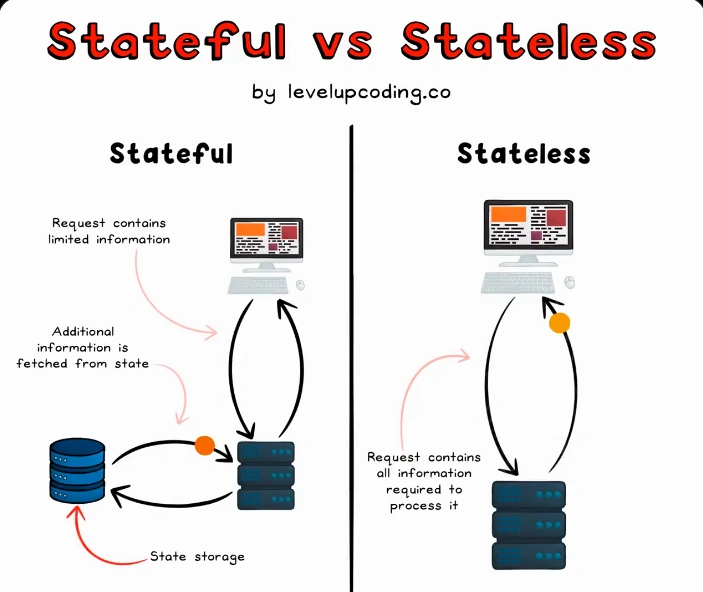
Stateful Applications
- Retain information about user interactions and past requests.
- Server keeps track of the user’s session state, allowing users to pick up where they left off.
- Examples include online banking and email.
- Characteristics:
- Context-aware: Transactions are influenced by prior interactions.
- Server dependency: Requests are typically processed by the same server.
- Features tracked: Preferences, recent activity, and window location.
- Challenges:
- More complex session management and load balancing.
- Increased resource utilization for managing session data.
- Greater risk of session loss if a server fails, unless replicated.
Stateless Applications
- Do not store information about previous interactions.
- Treat every transaction as independent and isolated.
- Examples include online searches and vending machine operations.
- Characteristics:
- No context: Each request starts fresh.
- Server independence: Requests can be handled by any server.
- Advantages:
- Simpler development and maintenance.
- Greater scalability and fault tolerance.
- Lower resource utilization.
Comparison
- Scalability: Stateless apps are more scalable due to independent transactions.
- Fault Tolerance: Stateless apps are less affected by server failures.
- Complexity: Stateless apps are simpler to develop; stateful apps require careful state management.
- Resource Use: Stateless apps are more resource-efficient.
State and Containers
- Containerization:
- Initially designed for stateless apps, enabling portability and flexibility.
- Stateful apps are now being containerized for enhanced speed and storage capabilities.
- Management:
- Tools like Kubernetes and StatefulSets allow for efficient management of both stateful and stateless containers.
- Decision Factors:
- Stateless is ideal for temporary data needs.
- Stateful is better for apps needing continuity across sessions.