distributedsystem/microservice y3s1/lecturenotes/ds distributedsystem
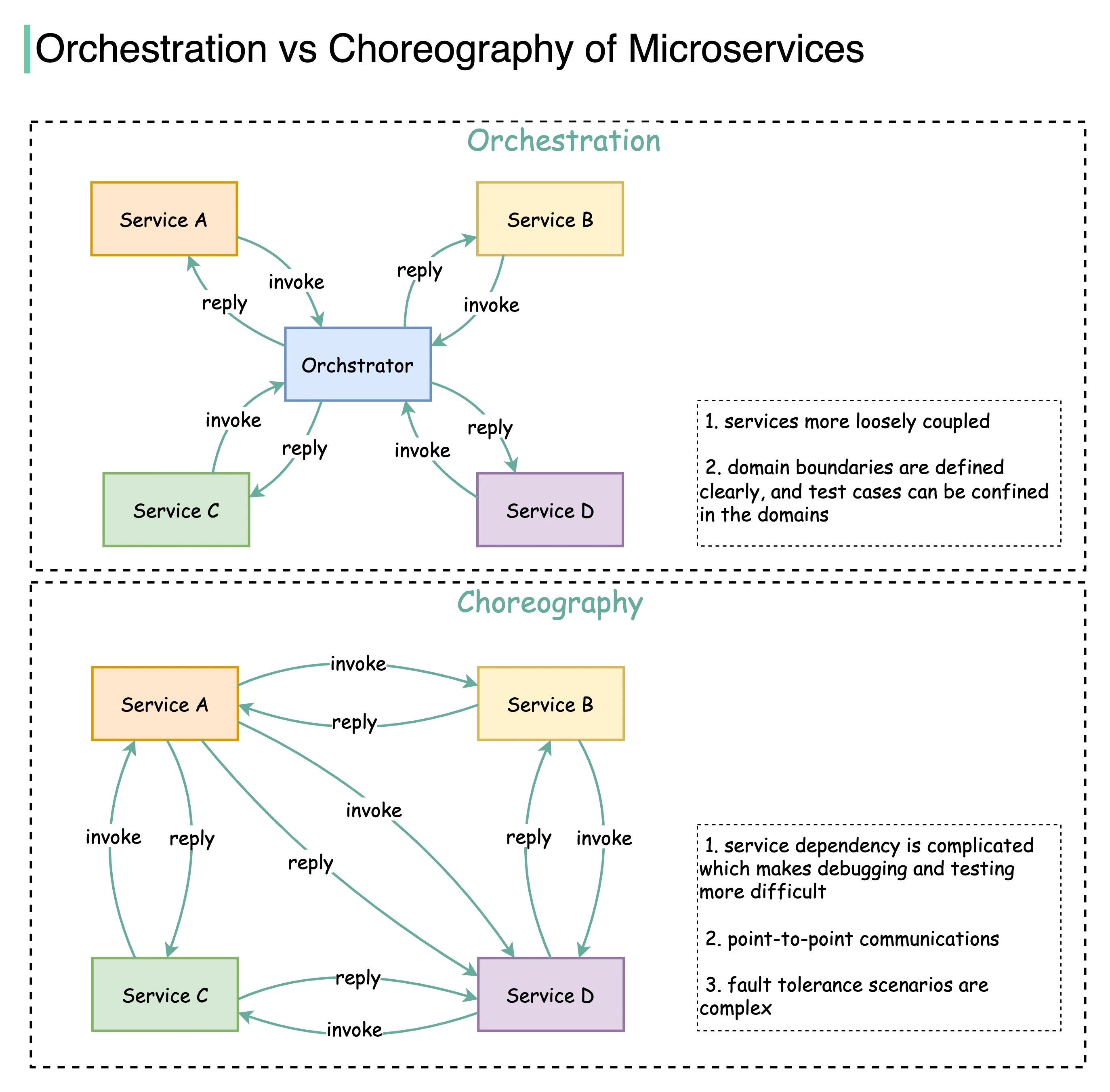
Choreography
Choreography is like having a choreographer set all the rules. Then the dancers on stage (the microservices) interact according to them. Service choreography describes this exchange of messages and the rules by which the microservices interact.
Technology Examples:
- Event-driven systems using Apache Kafka, RabbitMQ, or EventBridge.
- Choreography is common in distributed microservices with event sourcing.
Orchestration
Orchestration is different. The orchestrator acts as a center of authority. It is responsible for invoking and combining the services. It describes the interactions between all the participating services. It is just like a conductor leading the musicians in a musical symphony. The orchestration pattern also includes the transaction management among different services.
-
Reliability - orchestration has built-in transaction management and error handling, while choreography is point-to-point communications and the fault tolerance scenarios are much more complicated.
-
Scalability - when adding a new service into orchestration, only the orchestrator needs to modify the interaction rules, while in choreography all the interacting services need to be modified.
Some limitations of orchestration:
-
Performance - all the services talk via a centralized orchestrator, so latency is higher than it is with choreography. Also, the throughput is bound to the capacity of the orchestrator.
-
Single point of failure - if the orchestrator goes down, no services can talk to each other. To mitigate this, the orchestrator must be highly available.
Real-world use case: Netflix Conductor is a microservice orchestrator(Title Unavailable | Site Unreachable)
Technology Examples:
- BPMN engines like Camunda, Apache Airflow, AWS Step Functions.
- Common in monoliths or tightly coordinated microservices.
Is Kubernetes an orchestrator ?
- Kubernetes is an orchestrator — but for infrastructure-level workflows.
- Service orchestrators like Camunda, Step Functions, and Airflow are for business or service-level workflows.
- What is Step Functions? - AWS Step Functions
[!video]- AWS Step Functions Introduction - What is it and Why is it Useful?
- You can use both together: Kubernetes runs your microservices, and Camunda/AWS coordinates how they interact.