The Story
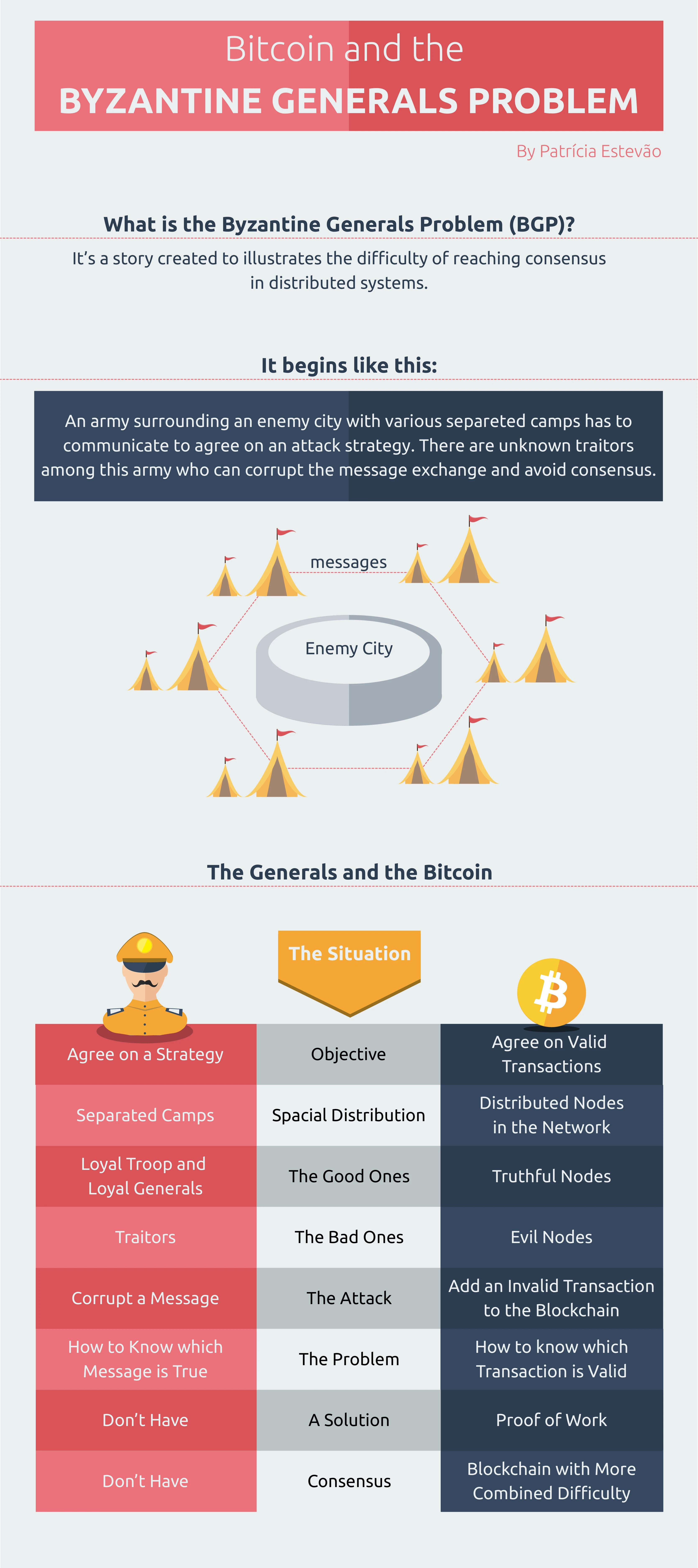
Imagine several generals of the Byzantine army, each leading a division, have surrounded an enemy city. They must agree on a common plan: either attack or retreat. The key point is:
- If they all attack together, they’ll win.
- If some attack and others retreat, they’ll lose badly.
The Challenges
- The generals are spread out, and can only communicate by sending messengers.
- One or more generals might be traitors (Byzantine faults) who:
- Send conflicting messages
- Lie or behave unpredictably
- Try to cause the loyal generals to disagree
The Problem
How can all loyal generals reach agreement, even if some of them are malicious?
Here’s where it gets tricky:
- Suppose General A sends “Attack at dawn” to both General B and C.
- A traitorous General A might send “Retreat at dusk” to C instead.
- Now B and C received conflicting information and don’t know whom to trust.
Even if the messengers are reliable, the **traitor can still manipulate the outcome**.
The Result:
This problem proves that:
- In a system with n generals, to tolerate f traitors, you need at least 3f + 1 total generals.
- That means: to tolerate 1 faulty node, you need at least 4 total nodes.
This insight is the basis for Byzantine Fault Tolerant (BFT) algorithms.
Real-World Relevance
- The problem models real-world distributed systems, especially in blockchains, distributed databases, and financial systems.
- Solutions like PBFT (Practical Byzantine Fault Tolerance) and Tendermint are used in systems where nodes may be compromised or behave maliciously.
Comparison: The Two Generals problem vs Byzantine Generals
| Feature | Two Generals Problem | Byzantine Generals Problem |
|---|---|---|
| Goal | Two generals agree on whether to attack. | Multiple generals reach agreement on a plan (attack/retreat). |
| Type of Fault | Unreliable communication (messages may be lost). | Faulty/malicious nodes (traitors can lie or behave arbitrarily). |
| Trust Assumption | Both generals are honest. | Some generals may be malicious or traitorous. |
| Main Challenge | Can’t be sure a message was received (infinite acknowledgment loop). | Some nodes may lie and send conflicting messages to others. |
| Communication Channel | Faulty (messages may be lost). | Reliable, but nodes may be faulty (Byzantine behavior). |
| Problem Type | Agreement is impossible due to network unreliability. | Agreement is hard due to untrusted participants. |
| Solvability | Impossible with just 2 nodes over unreliable channels. | Solvable with ≥ 3f + 1 nodes to tolerate f faulty nodes. |
| Real-World Analogy | Email lost in spam folder—did they read it? | Group chat where one person lies to different members. |
| Typical Solution | No perfect solution. Approximated using retries, timeouts. | Solved using Byzantine Fault Tolerant algorithms (e.g., PBFT, Tendermint). |
Summary
- Two Generals Problem = Problem with message delivery reliability
- Byzantine Generals Problem = Problem with trustworthiness of nodes.
Both problems inspired modern distributed consensus systems — but Byzantine fault tolerance is more general and harder to solve.
Distributed Systems 2.2: The Byzantine generals problem