distributedsystem systemdesign database/redis
Warning
It is now recommended to use Redis Streams for this instead of the recipe described in “Pattern: Reliable Queue”.
A Reliable queue pattern ensures that messages are processed exactly once, even if the consumer crashes. Redis provides the LMOVE command, which moves messages between lists atomically, ensuring message reliability.
How it Works ?
Problem: Redis Lists can lose messages if a consumer crashes after popping a message. Instead, the Reliable Queue Pattern uses two lists.
- Main Queue(pending queue) —> Stores new messages
- Processing Queue —> Temporary queue for messages being processed.
Instead of RPOP, we use:
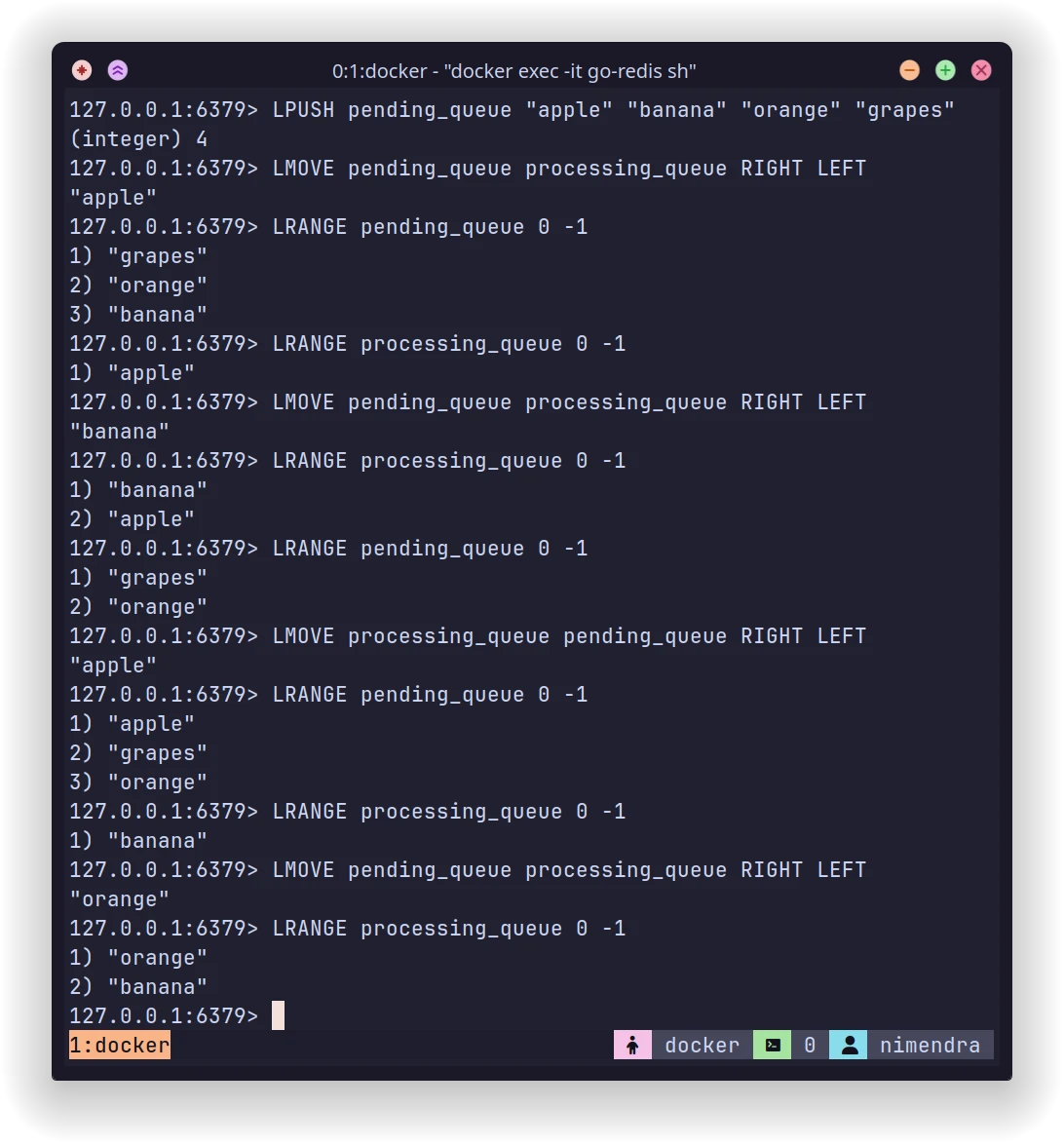
LMOVE pending_queue processing_queue RIGHT LEFT
RIGHT→ Take the element from the end (right) ofpending_queue
LEFT→ Insert it at the front (left) ofprocessing_queue
Other Variations
Command Effect LMOVE source destination LEFT LEFTMove from front of sourceto front ofdestinationLMOVE source destination LEFT RIGHTMove from front of sourceto end ofdestinationLMOVE source destination RIGHT LEFTMove from end of sourceto front ofdestinationLMOVE source destination RIGHT RIGHTMove from end of sourceto end ofdestination
LMOVEcommand return that value to consumer and move it(copy) to another queue(processing_queue).(RPOPonly return value)- The message moves atomically from
pending_queuetoprocessing_queue. - If processing fails, unprocessed messages stay in
processing_queuefor retries.
What Does "Atomically Moves" Mean?
When we say “atomically moves”, we mean that the operation happens as a single, indivisible step, ensuring that:
- No Other Operation Can Interrupt It
- If a message is moved from
pending_queuetoprocessing_queue, it happens entirely or not at all.- No other Redis command or external process can see an intermediate state where the message is in both queues or missing.
- Prevents Race Conditions
- If multiple consumers try to take messages from
pending_queue, Redis ensures that only one consumer gets a specific message.- No duplicate processing occurs due to concurrent accesses.
- Guarantees Data Integrity
- If a consumer crashes, the message remains in
processing_queue, allowing it to be retried.
flowchart TD
A[Producer] -->|LPUSH| B[pending_queue]
B -->|LMOVE RIGHT LEFT| C[processing_queue]
C -->|Consumer Processes| D{Success?}
D -->|YES, LREM| E[Acknowledgment, Remove from processing_queue]
D -->|NO,LMOVE RIGHT LEFT| B[Requeue to pending_queue]
Producer
- Adds messages to
pending_queueusingLPUSH.
Consumer
- Uses
LMOVEto atomically transfer messages toprocessing_queue. - Processes the message.
- If successful, the message is removed.
- If failed, the message is moved back for retry.
Retry Mechanism
- A background worker scans
processing_queuefor stuck messages (e.g., processing timeout). - Moves unprocessed messages back to
pending_queueusingLMOVE.
Difference Between
LREMandLPOPin Redis
Command Purpose How It Works Use Case LREMRemoves specific elements by value Deletes one or more occurrences of a specified value in a list Removing specific messages from a queue, deduplication LPOPRemoves and returns the first element Always removes only the first item in the list (left-most) Processing a queue (FIFO - First In, First Out)
Go Implementation
package main

import (
	"context"
	"fmt"
	"log"
	"time"

	"github.com/redis/go-redis/v9"
)

var ctx = context.Background()
var rdb = redis.NewClient(&redis.Options{
	Addr: "localhost:6379",
})

// Adds a message to the pending queue
func enqueueMessage(message string) error {
	return rdb.LPush(ctx, "pending_queue", message).Err()
}

// Moves message from pending queue to processing queue
func dequeueMessage() (string, error) {
	msg, err := rdb.LMove(ctx, "pending_queue", "processing_queue", "RIGHT", "LEFT").Result()
	if err == redis.Nil {
		return "", nil // No messages available
	}
	return msg, err
}

// Process messages reliably
func processMessages() {
	for {
		message, err := dequeueMessage()
		if err != nil {
			log.Println("Error moving message:", err)
			continue
		}

		if message == "" {
			time.Sleep(1 * time.Second) // No messages, wait before polling
			continue
		}

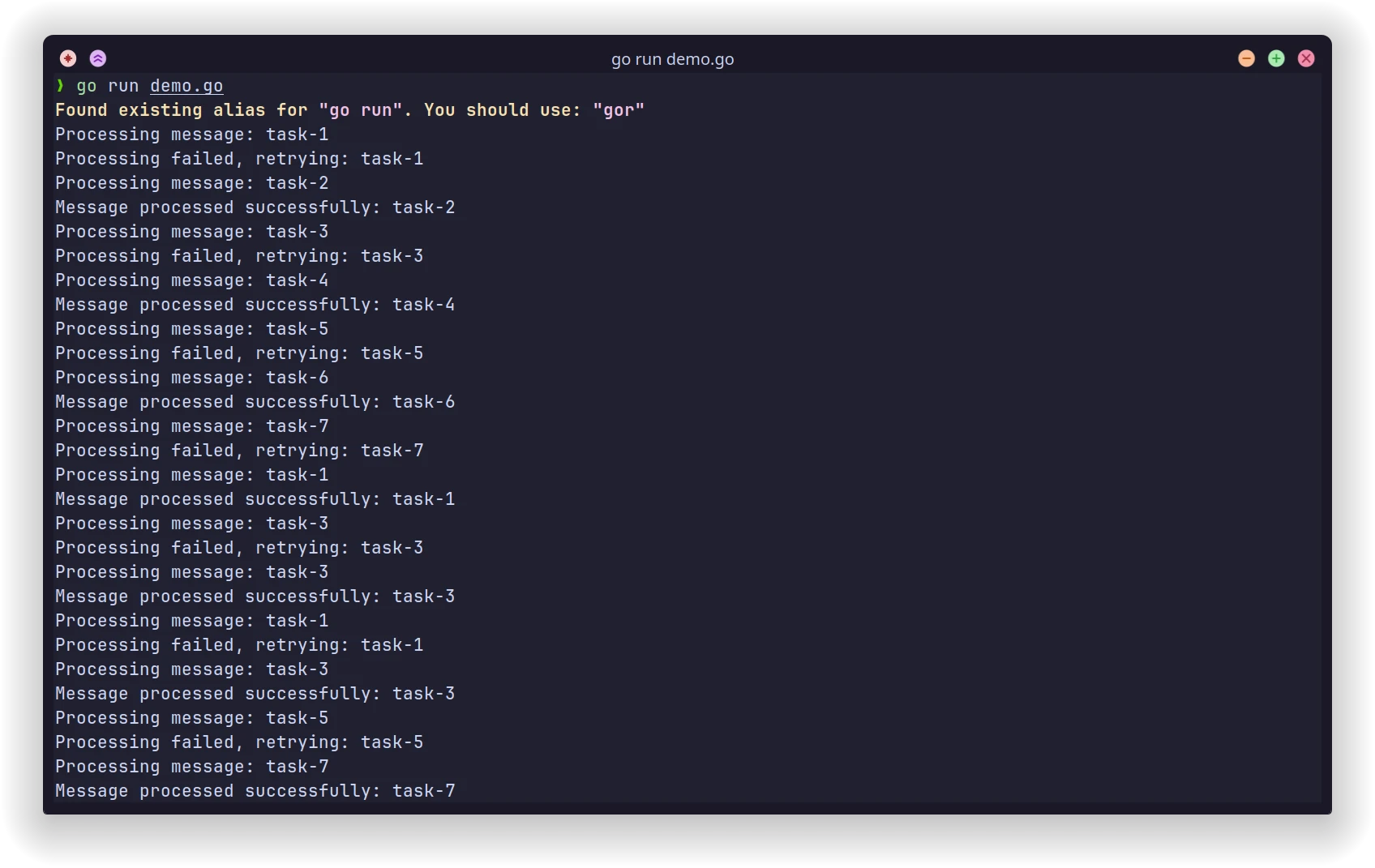
		fmt.Println("Processing message:", message)

		// Simulating failure or success
		if time.Now().Unix()%2 == 0 {
			fmt.Println("Message processed successfully:", message)
			rdb.LRem(ctx, "processing_queue", 1, message) // Remove from processing queue
		} else {
			fmt.Println("Processing failed, retrying:", message)
			// Move back to pending queue
			rdb.LMove(ctx, "processing_queue", "pending_queue", "RIGHT", "LEFT")
		}
	}
}

func main() {
	// Simulating producer
	enqueueMessage("task-1")
	enqueueMessage("task-2")
	enqueueMessage("task-3")

	// Start processing
	processMessages()
}