sitereliabilityengineering ai/agenticai agents platformengineering
Servicenow AI Control Tower
Now Assist and the Future of Autonomous IT Operati… - ServiceNow Community
AI-Powered Root Cause Analysis at Scale
5. AgentOps - Deploying to Production
Core Idea
Now Assist SRE Specialist moves AI from a chatbot standing outside the workflow to a coworker inside it: it triages incidents, writes up what happened, and flags risky changes, with a human approving anything critical.
- The bottleneck it attacks: every alert, dependency question, and change decision waits for a person, so problems escalate upward and fixes take longer.
- Three jobs: incident triage (gather live data, size the impact, propose a fix, human-in-the-loop for critical work), automatic postmortem and knowledge-base drafting, and change-risk warnings drawn from history.
- Claimed results: average fix time 4.2h → 1.8h, escalations to senior engineers down 22%, fruitless documentation searches 34% → 8%.
- The note’s caution: the “not replacing humans” framing reads as a matter of time, and junior engineering roles are the exposed ones.
The Problem
Right now, when an incident breaks a company’s IT system, a person has to figure out what’s wrong. Every alert, every “what depends on what” question, every decision about whether a change is risky — it all waits for a human to look at it and decide.
This works fine when a company is small. But as companies grow bigger, this becomes a huge bottleneck. Teams end up with what people jokingly call the “Monday Morning Briefing” — a list of bad news:
- More problems are getting pushed up to the most senior (and most expensive) engineers
- It’s taking longer and longer to fix things
- When people search the internal help documents, they often find nothing useful.
- Changes to the system keep accidentally breaking other things
ServiceNow’s new tool, called Now Assist SRE Specialist (launched June 2026), is meant to fix this. Instead of being a chatbot you ask questions to, it’s an AI that works inside the actual operations system, doing real work automatically.
How AI Support Has Evolved
Think of it in four stages:
- Old days: No AI at all - everything manual
- Basic AI: Simple automation for repetitive tasks
- Chatbot AI: An AI assistant you could ask questions, kind of like an outside consultant emailing you advice
- Now Assist (today): An AI that acts like a coworker who’s already inside the problem. it has already checked the maps, already looked at what’s connected to what, and hands you a proposed fix to approve
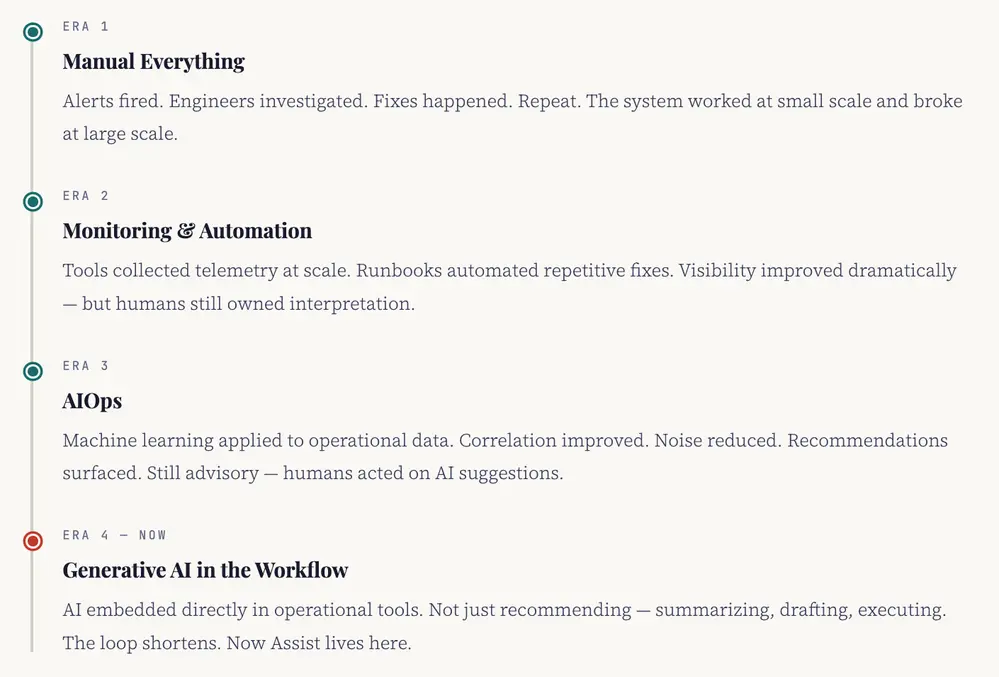
The big shift isn’t that the AI got smarter. It’s that the AI now lives inside the workflow instead of standing outside it.
What the AI Actually Does
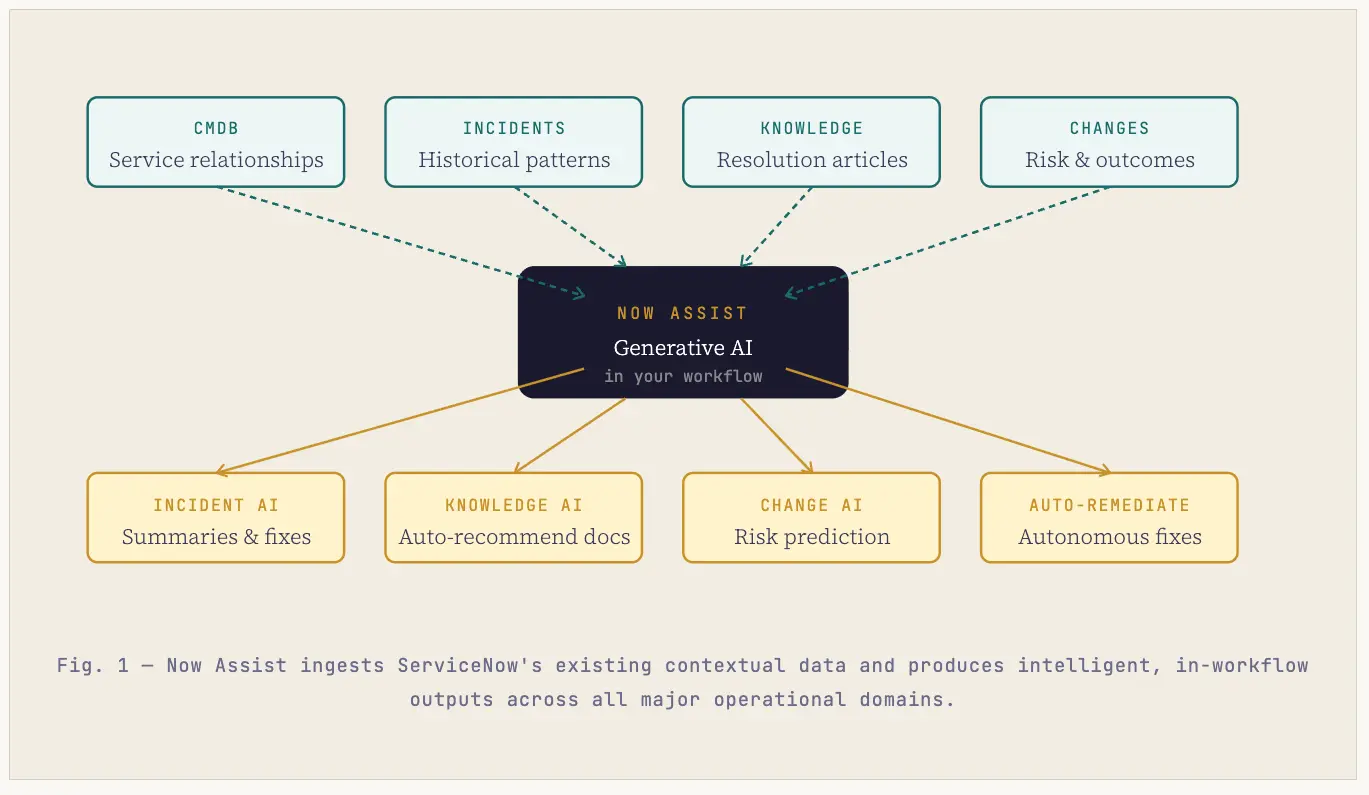
1. Handling Incidents - From Digging to Doing
When something breaks badly, an engineer normally spends the first 20–30 minutes just doing detective work: reading descriptions, checking configurations, searching for similar past problems, digging through documentation.
The AI does this instantly instead:
- It pulls together live data, figures out how big the impact is, and drafts a suggested fix - often before a human even opens the ticket
- For anything critical, it doesn’t act alone. It proposes the fix and waits for a human to approve it (this is called human-in-the-loop)
2. Writing Up What Happened, Automatically
After an incident, someone is supposed to document what went wrong and how it was fixed. In practice, this step often just gets skipped because everyone’s exhausted.
The AI handles this too, extending automation into incident documentation:
- It reads through chat logs, deployment records, and system data to build a timeline of exactly what happened
- It drafts the full incident report and root-cause analysis
- It writes up the fix as a help-article draft and adds it to the company’s knowledge base - so the next person who hits the same problem can actually find an answer
3. Catching Risky Changes Before They Happen
When someone proposes a change to the system, it’s hard for a human reviewer to remember every similar change that’s gone wrong in the past.
The AI compares the proposed change against history and can warn, for example: “This type of database change has caused three serious incidents in the last 18 months when applied to this specific system.” It can also suggest extra testing or requiring extra approvals for risky changes.
Before and After: The Numbers
| What’s Measured | Old Way (Manual) | With Now Assist |
|---|---|---|
| Average time to fix a problem | 4.2 hours | 1.8 hours |
| Problems escalated to senior engineers | Up 18% | Down 22% |
| Searches that find nothing useful | 34% of the time | 8% of the time |
| Outages caused by changes | Frequent | Rare |
| Safety of automated actions | Low — scripts run blind | High — checked against live, real data |
A Thought Worth Sitting With
The article claims this isn’t about replacing humans, but that reads less like a permanent boundary and more like a matter of time.
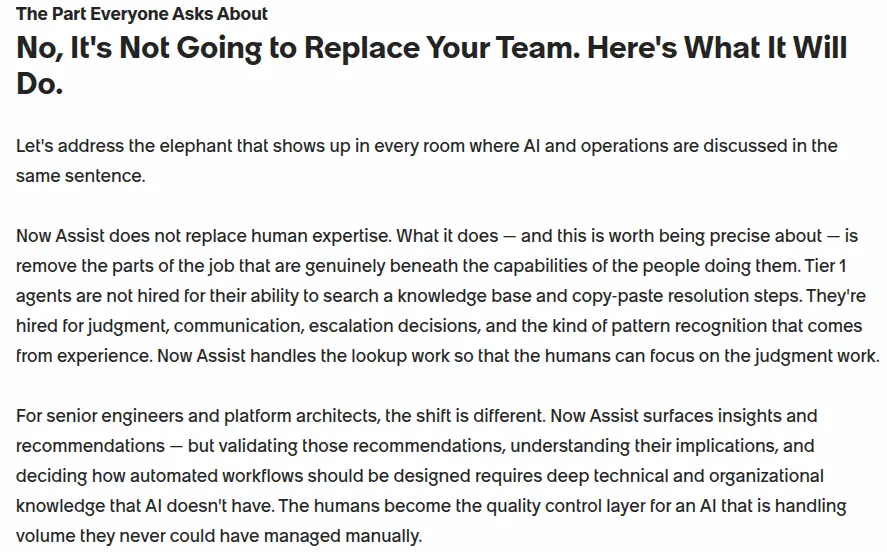
It’s worth being honest about where this is headed. AI systems like this get better over time by learning from what human engineers do, a process similar to reinforcement learning, where the system improves based on feedback and outcomes.
- e.g, Self Improving AI Agents (Self-Improving AI — The Hermes Feature That Actually Works)
That means it’s realistic to expect this kind of AI to eventually take over more of the work currently done by experienced engineers. And there’s a real risk that companies may lean on it to cut costs in the short term, potentially reducing junior engineering roles, even while still depending heavily on senior expertise to guide and correct the system. That tension is worth watching as these tools roll out.