Core Idea
Jev is a fast AI decision model designed for software (while most of the other models designed for the works with the humans), not for writing text.
You give it some state (text or structured data) and ask narrow questions. It returns a bounded answer plus probabilities. Your application then decides whether to act, escalate to a human, or call a larger reasoning model.
The important distinction is:
Jev can guarantee that an answer stays inside the allowed output format. It cannot guarantee that the answer is correct.
The public evidence suggests Jev can be very fast and cheap for repeated, narrow decisions. However, it has not yet been publicly proven to be a new scientific model category, more accurate than strong classifiers, or reliably calibrated under real-world distribution shift.
1. What Jev is
Jev is presented by TypeSafe AI as a System One Model: a model optimized for quick, structured decisions that software can use directly.
Instead of generating paragraphs, code, or explanations, it returns one of three decision types:
| Type | What it does | Example |
|---|---|---|
| Noul | Yes/no probability | “Is this message spam?” |
| Choice | Picks from allowed options | billing, technical, sales |
| Score | Rates something on ordered levels | low, medium, high |
A single state can be reused for several questions, which may reduce repeated processing.
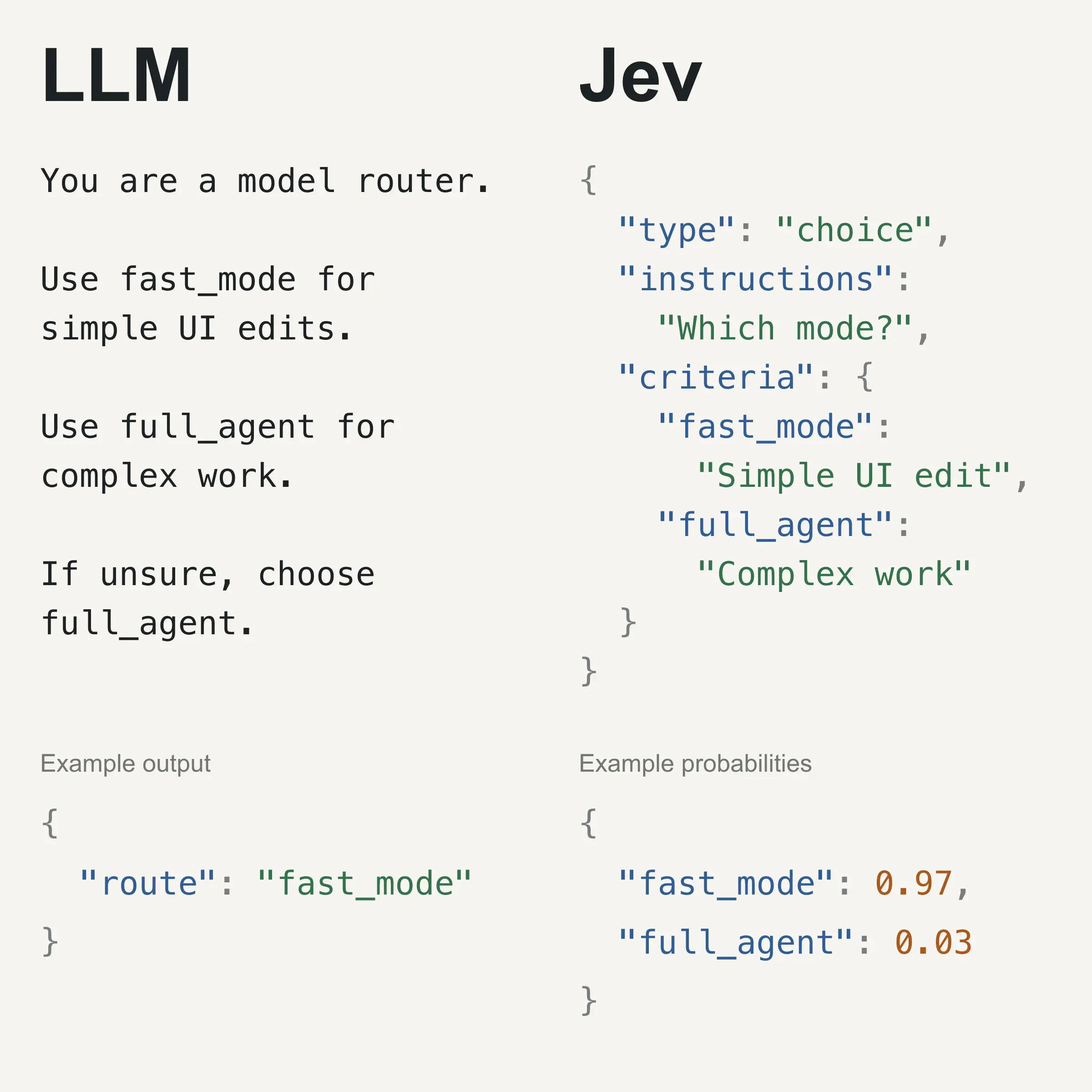
Simple mental model
Think of Jev as a set of fast AI gauges. Each gauge answers one narrow question. Your normal application code still owns the rules, thresholds, and actions.
Kahneman’s idea is “fast intuition vs slow reasoning”; TypeSafe applies that idea to AI as “fast decision models vs deeper reasoning models.”
Daniel Kahneman’s Thinking, Fast and Slow describes two styles of human thinking:
- System 1 is fast, automatic, and intuitive.
- System 2 is slower, deliberate, and used for harder reasoning.
TypeSafe borrows this idea for Jev, calling it a System One Model. The idea is that Jev should handle fast, narrow decisions such as classification, scoring, routing, or yes/no judgments, while harder cases can be passed to a larger reasoning model. The report explicitly says the name is inspired by Kahneman’s System 1/System 2 distinction.
For example, Jev might quickly decide whether a support ticket is about billing, technical support, or account access. A larger reasoning model would be more suitable if the case requires investigation, planning, or a detailed explanation.
The important limitation is that this is mainly an analogy. Kahneman’s System 1 describes human cognition, while Jev is an AI system designed for fast structured decisions. Calling it “System One” does not by itself prove that it is a completely new scientific model category.
2. What makes it different from a normal LLM?
A normal LLM is designed to generate tokens one after another. That is useful for reasoning, writing, code, explanations, and planning, but it adds output-generation cost and latency.
Jev is designed to return small, fixed decision outputs instead.
This can make it attractive when you need to ask many simple questions such as:
- Which queue should this support ticket go to?
- Is this document relevant?
- Which tool should an agent use?
- Does this output violate a rule?
- Should this case be automatically handled or escalated?
A fair comparison is not “Jev versus a large LLM writing a paragraph.” It is Jev versus the cheapest alternative that reaches the required quality, such as a constrained LLM, small model, classifier, reranker, or rules system.
3. What is actually supported by public evidence?
Strongly supported
- Jev returns structured, bounded decisions rather than general text.
- Choice, Score, and Noul are public API primitives.
- Multiple questions can share the same state.
- The output contract prevents invalid Choice or Score values.
- TypeSafe reports low latency and very low inference cost on its published workflows.
Plausible, but not proven
- Jev probably avoids much of the sequential text-decoding work of normal LLMs.
- Its shared-state design may make many-question workloads especially efficient.
- It may be useful as a middle layer between simple classifiers and expensive reasoning models.
Still unverified
- The exact model architecture.
- Whether it is transformer-based.
- Whether its training method, RLCD, is technically novel.
- Whether its probabilities are well calibrated across real customer data.
- Whether it beats fine-tuned classifiers on stable labelled tasks.
- Whether independently returned answers stay logically consistent with each other.
4. Type safety does not mean truth
This is the most important limitation.
Suppose the allowed answers are:
approved
rejected
unknown
Jev can be prevented from returning something outside those options. That is a real engineering benefit.
But it can still return:
approvedwhen the correct answer is rejected.
So Jev reduces format and schema errors, not all semantic errors.
The same applies to the claim that it “cannot hallucinate.” A narrow interpretation is defensible: it cannot invent an output outside the declared schema. But it can still make a valid-looking but wrong decision.
5. What does “calibrated probability” mean?
Good calibration means the probability matches real-world correctness over many examples.
For example, if a model gives 0.9 confidence to 100 similar decisions, roughly 90 of them should be correct.
A probability that merely looks confident is not enough.
To verify Jev’s calibration properly, public tests would need measures such as:
- reliability diagrams;
- Brier score or log loss;
- high-confidence error rate;
- performance under class imbalance;
- performance when users, domains, wording, or base rates change.
The reviewed public material does not yet provide enough evidence to establish this broadly.
6. Benchmark evidence
TypeSafe workflow evaluation
TypeSafe’s published evaluation covered 711 cases across four workflows. In the transcribed aggregate result:
| System | Reference agreement | Cost | Time |
|---|---|---|---|
| Jev | 67.8% | $0.0004 | 0.4 s |
| Strong visible LLM comparator | 74.1% | $0.0836 | 23.3 s |
This suggests a large efficiency advantage, but not an accuracy win.
A major limitation is that the reference answers were derived from other large models rather than independently verified human ground truth. The benchmark therefore measures agreement with a model-generated reference policy, not pure correctness.
Independent Every test
An independent test reported:
- 777 judgments in under 0.7 seconds;
- about $0.0025 estimated cost;
- Jev caught 6 of 7 planted defects in a small quality comparison;
- the stronger comparison model caught 7 of 7.
This supports the claim that Jev can be extremely fast and inexpensive, while also showing that semantic errors still occur.
7. Jev vs other approaches
| Approach | Best when | Main limitation |
|---|---|---|
| Rules | Logic is explicit and deterministic | Poor with fuzzy semantic judgments |
| Classical / fine-tuned classifier | Task and labels are stable | New labels often require retraining |
| Small constrained LM | Cheap local semantic classification | Quality and calibration may need tuning |
| Frontier LLM | Complex reasoning, planning, generation | Higher latency and cost |
| Jev | Many narrow, changing semantic decisions | Accuracy/calibration claims still need stronger evidence |
Jev’s likely sweet spot
Jev appears most useful when:
- the task is too semantic for simple rules;
- the questions or labels may change often;
- the answer space is bounded;
- many decisions must be made quickly;
- uncertain cases can be escalated.
For a stable task with lots of labelled data, a small trained classifier may still be cheaper and stronger.
8. Good and bad use cases
Good fit
- support routing;
- moderation triage;
- document classification;
- RAG filtering or ranking;
- LLM output checks;
- tool selection;
- quality-control checks;
- lead or case scoring;
- repeated semantic labelling.
Use carefully
- fraud detection;
- compliance;
- risk scoring;
- policy enforcement;
- information extraction;
- agent action selection.
These need real labelled validation, safe thresholds, auditability, and often human review.
Poor fit
- open-ended writing;
- code generation;
- multi-step planning;
- difficult mathematical reasoning;
- tasks that require gathering new evidence during inference;
- irreversible high-stakes actions with no verification path.
9. Best architecture: use Jev as a decision layer
A sensible pattern is:
input
  -> deterministic checks
  -> Jev for narrow semantic judgments
  -> high confidence: application rules act
  -> uncertain: human review
  -> complex case: reasoning LLM
A risky pattern is:
input -> Jev asks “what should we do?” -> irreversible actionThe first keeps business policy in normal code. The second hides too much policy and risk inside a model prediction.
10. Important engineering limitations
Independent answers may conflict
Jev’s questions are documented as independent. For example, it could theoretically return:
fraud = false
fraud_type = account_takeover
Your application may need a second request, a combined label, or deterministic validation to enforce consistency.
Unknown or out-of-domain inputs need an escape path
A fixed schema cannot automatically represent “I do not know” unless you provide something like:
unknown
other
needs_review
Even then, the model still has to learn when to select it.
Prompt injection is still possible
Typed outputs reduce what an attacker can make the model emit, but malicious input may still influence which valid option the model selects.
11. What would prove the bigger claims?
The strongest missing experiments are straightforward:
- Compare Jev against strict one-token LLM outputs, small models, and fine-tuned classifiers on the same human-labelled tasks.
- Publish calibration metrics and high-confidence error rates.
- Test domain shift, changed class frequencies, adversarial inputs, and unknown categories.
- Measure P50/P95/P99 latency as input size and question count grow.
- Publish enough detail about RLCD and the architecture to evaluate technical novelty.
Bottom line
Jev looks like a useful decision-serving primitive, not a replacement for LLMs.
Its strongest demonstrated advantage is the interface: software gets bounded, probability-bearing decisions instead of generated prose. Its speed and cost advantages are plausible and partly supported by early tests.
The biggest unanswered questions are semantic accuracy, real calibration, robustness under shift, and performance against strong task-specific classifiers.
For now, the safest interpretation is:
Use Jev for fast, bounded semantic decisions where application code keeps control and uncertain cases can be escalated.